


This series has been walking through the different ways datacenters connect optics to switch silicon, from pluggable transceivers to LRO to LPO:


If you haven’t read those, they are easy reads. I recommend skimming through them first.
Each step trades flexibility for efficiency. And the root source of the inefficiency is that long, noisy copper trace between the switch and the optics:
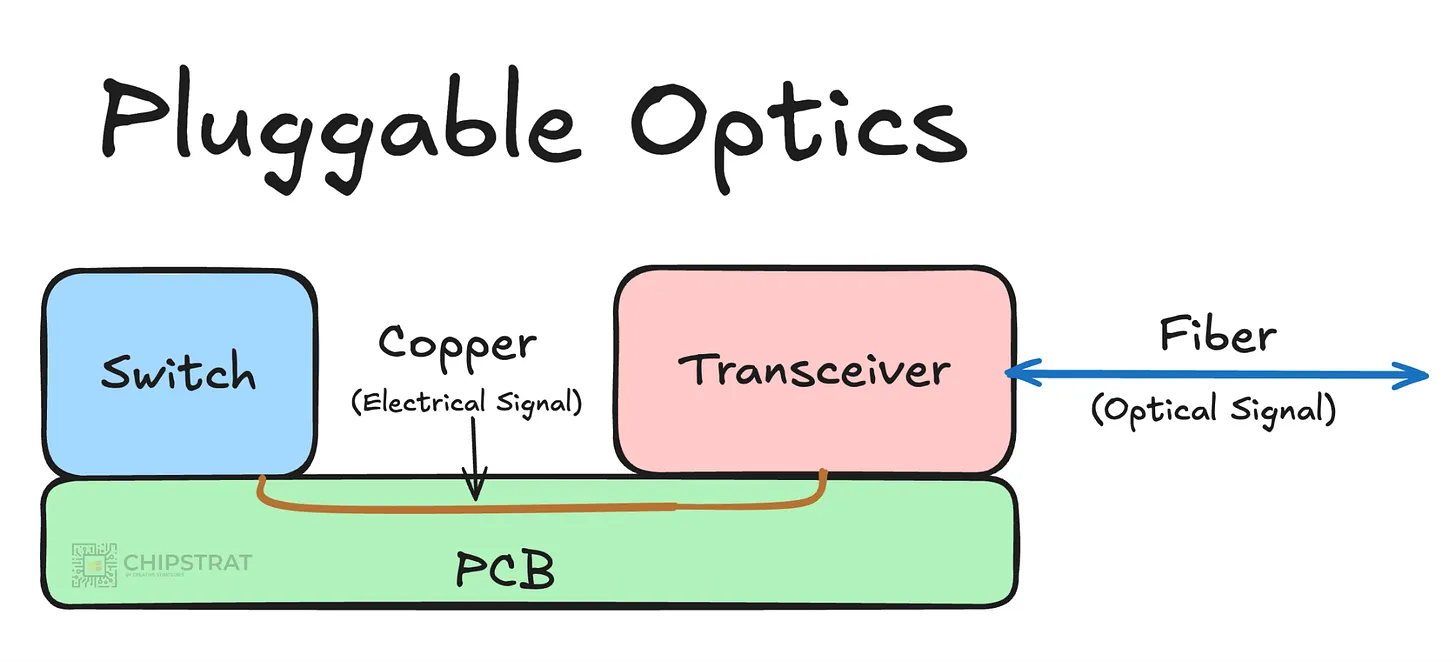
At modern lane rates (e.g 50G, 100G per lane), electrical signals pick up a ton of noise and distortion crossing the copper trace between the switch and the transceiver. Pluggable optics handle this with a DSP that overcomes the noise during transmit and receive. And LRO and LPO save power by relocating that DSP into the switch:
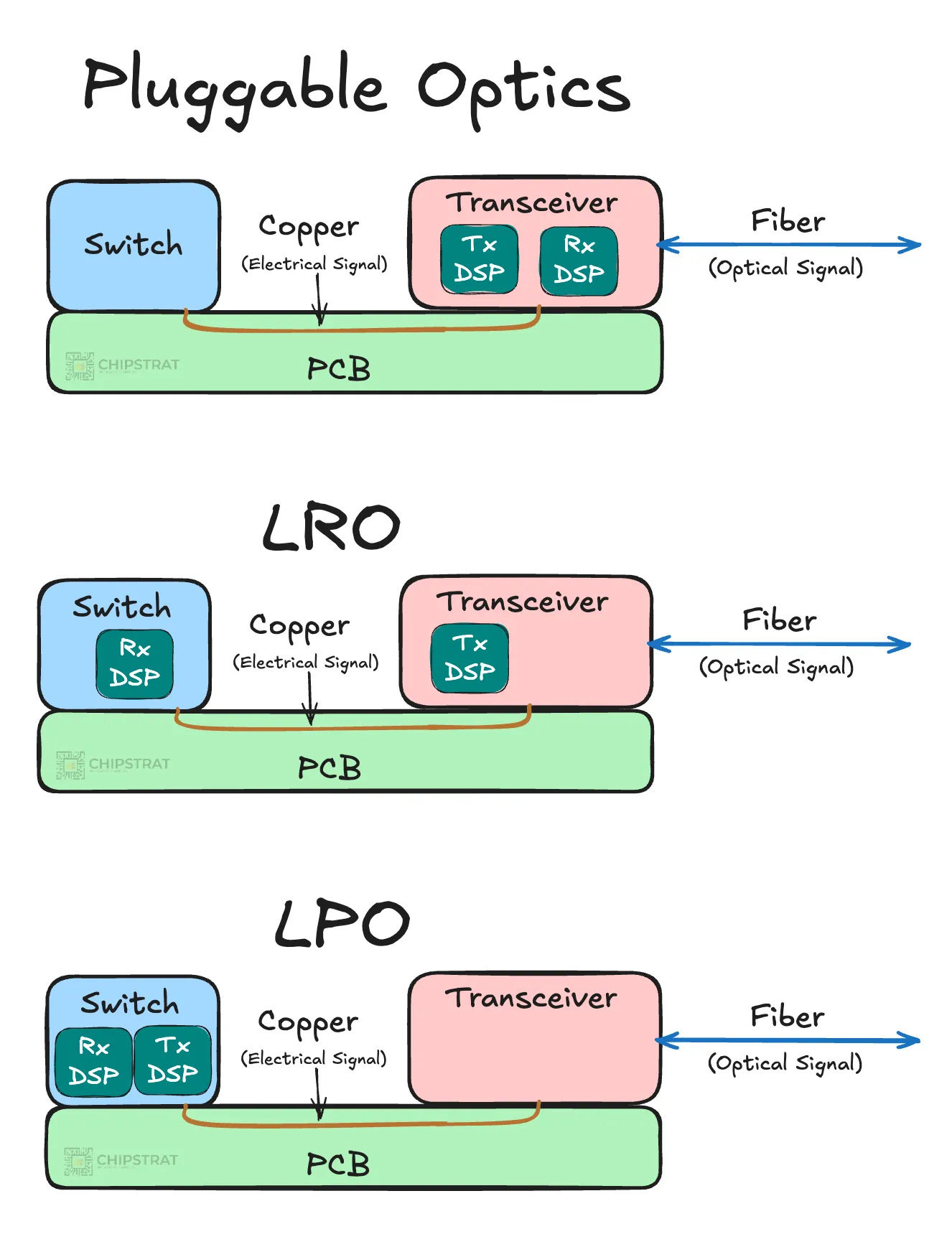
But the system becomes less modular and harder to mix-and-match.But why deal with that copper trace at all? What happens when you just... put the optics right next to the silicon?
NPO
Near package optics (NPO) brings the optics module on the same substrate or very close to the switch package, but not inside it:
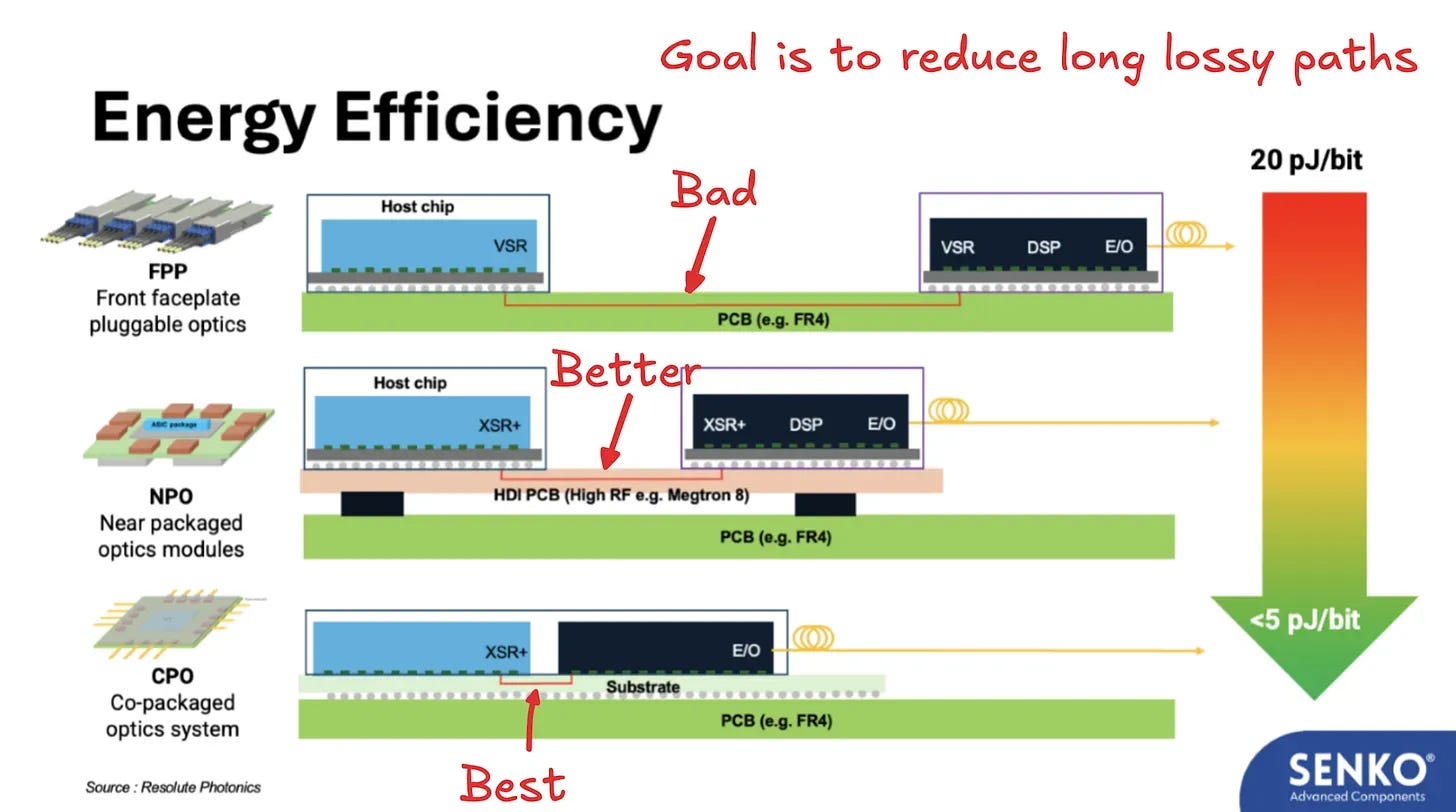
It’s close enough to reduce most copper impairments. This is a pragmatic middle ground, but the major players are largely leapfrogging it and going straight to CPO.
Might as well just reduce the copper distance to nearly zero right?
CPO
Finally! Co-packaged optics (CPO).
The optics move onto (or into) the switch package itself:
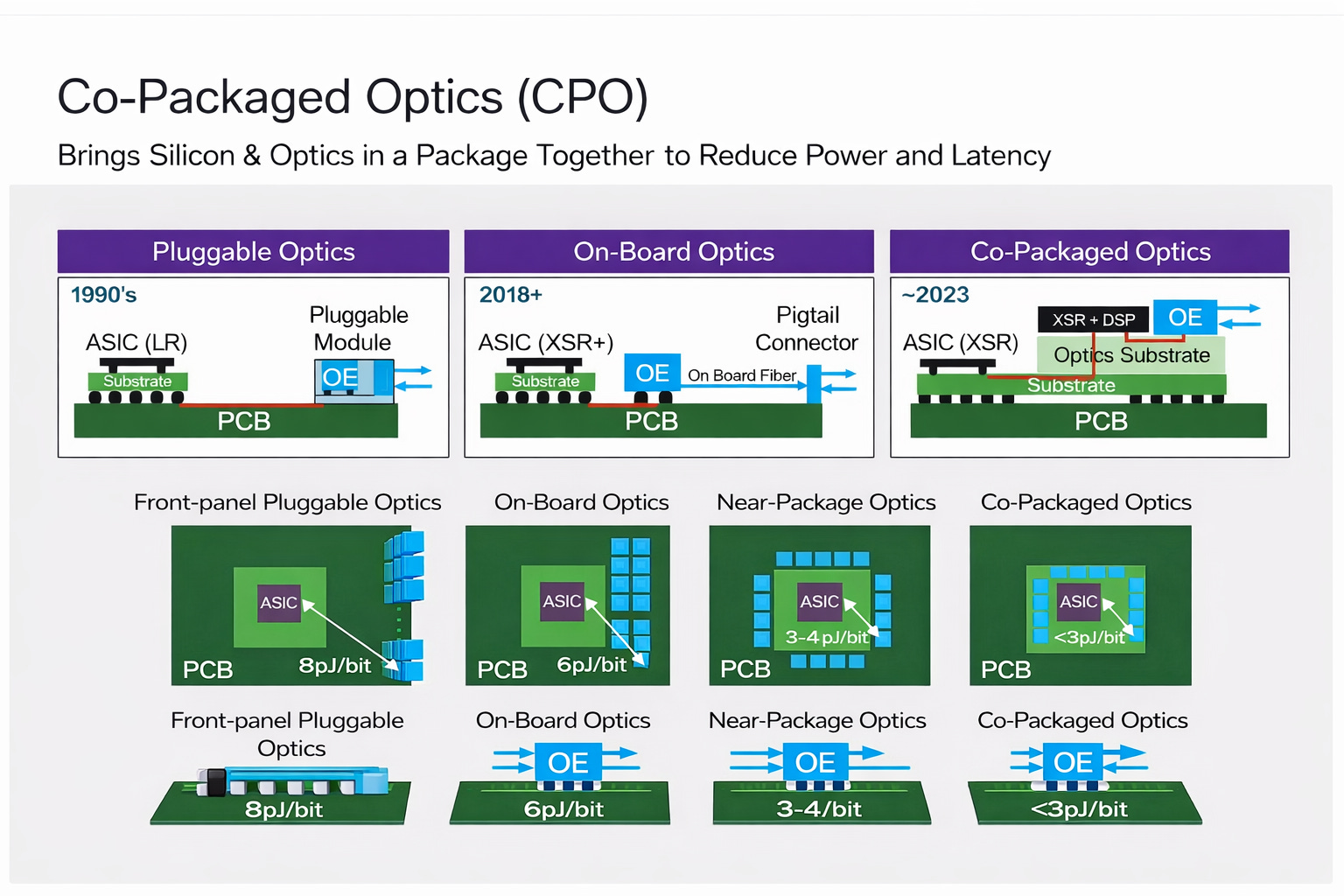
The electrical path between the switch die and the optical engine is now very short (millimeters or less). Since there’s no long copper trace, we needn’t have a DSP to compensate for it! Less silicon content, and less power.
There’s also much less SerDes power overhead as you only need extra short-reach (XSR) SerDes, the simplest, lowest-power tier:
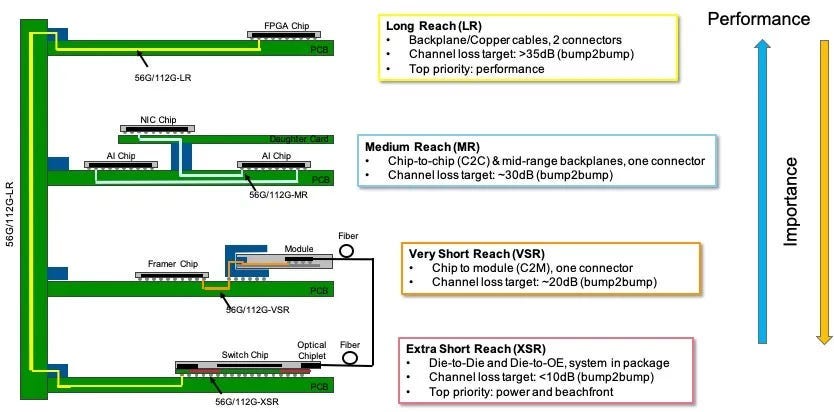
The simplest way to think about CPO is that the transceiver disappears and the optical engine moves onto the switch package itself.
How It Works
SemiAnalysis has an in-depth CPO article with a helpful diagram:
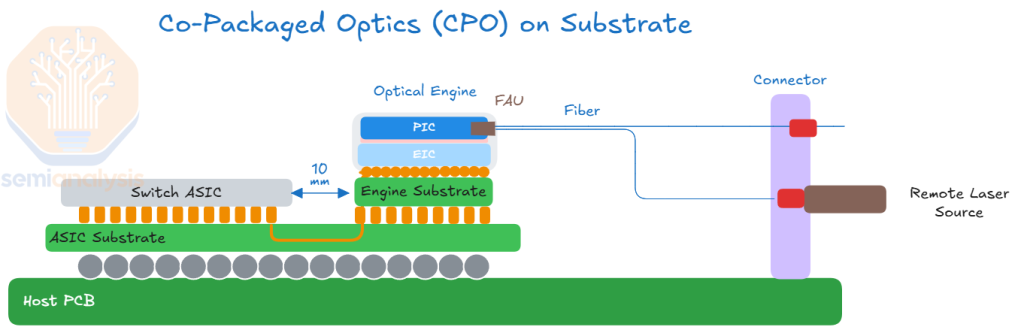
The optical engine is the core of CPO; it converts between the optical and electrical domains. Since the OE is on-package, fiber runs directly to the package edge. And now the electrical path to the switch is so short that signals stay clean without heavy conditioning. The switch ASIC’s SerDes handles what little remains.
Another helpful diagram from Nvidia’s blog. The red circles highlight noisy copper channels. Notice how CPO eliminates most of them:
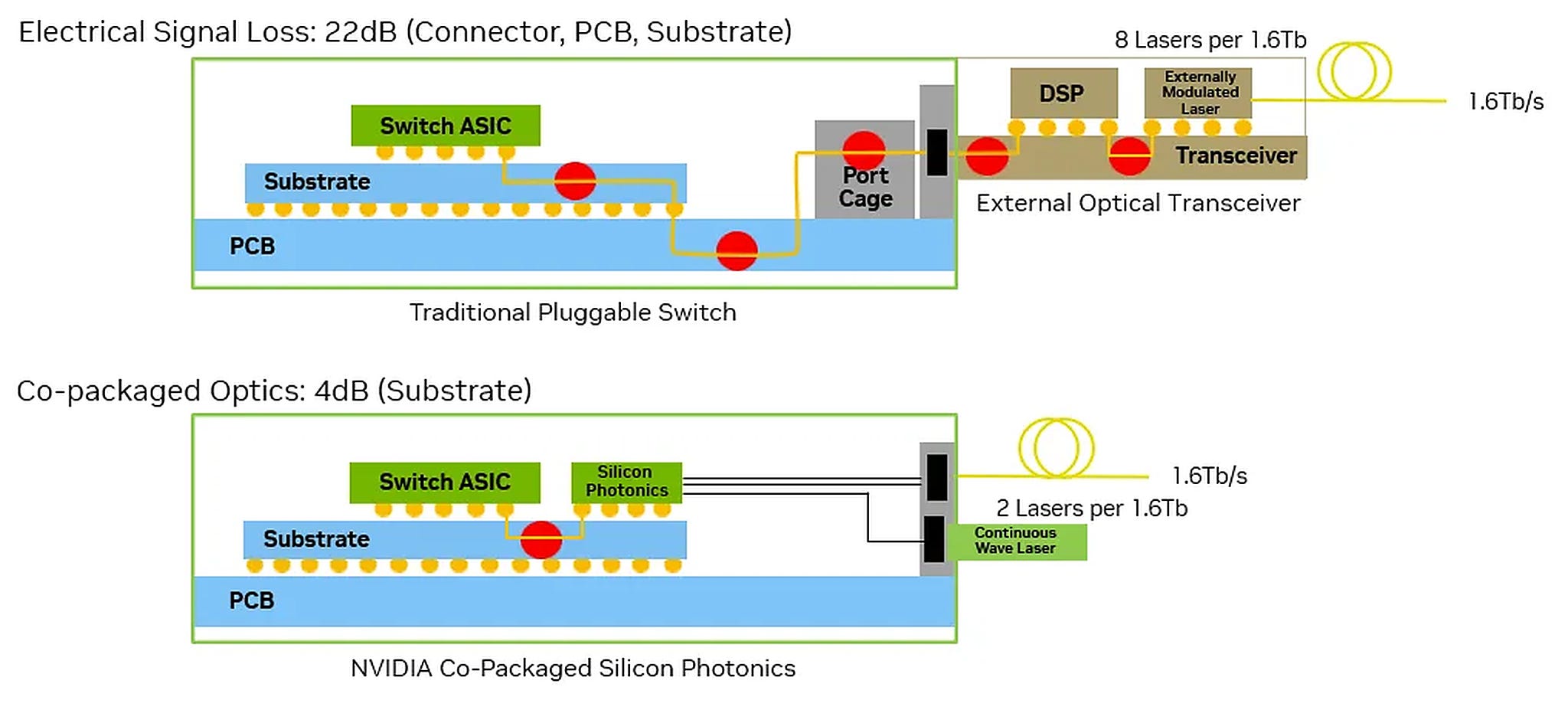
CPO cuts down on the overall power consumption, too. Per this example from Nvidia, power consumption cuts down from 30W for pluggables to 9W for CPO:
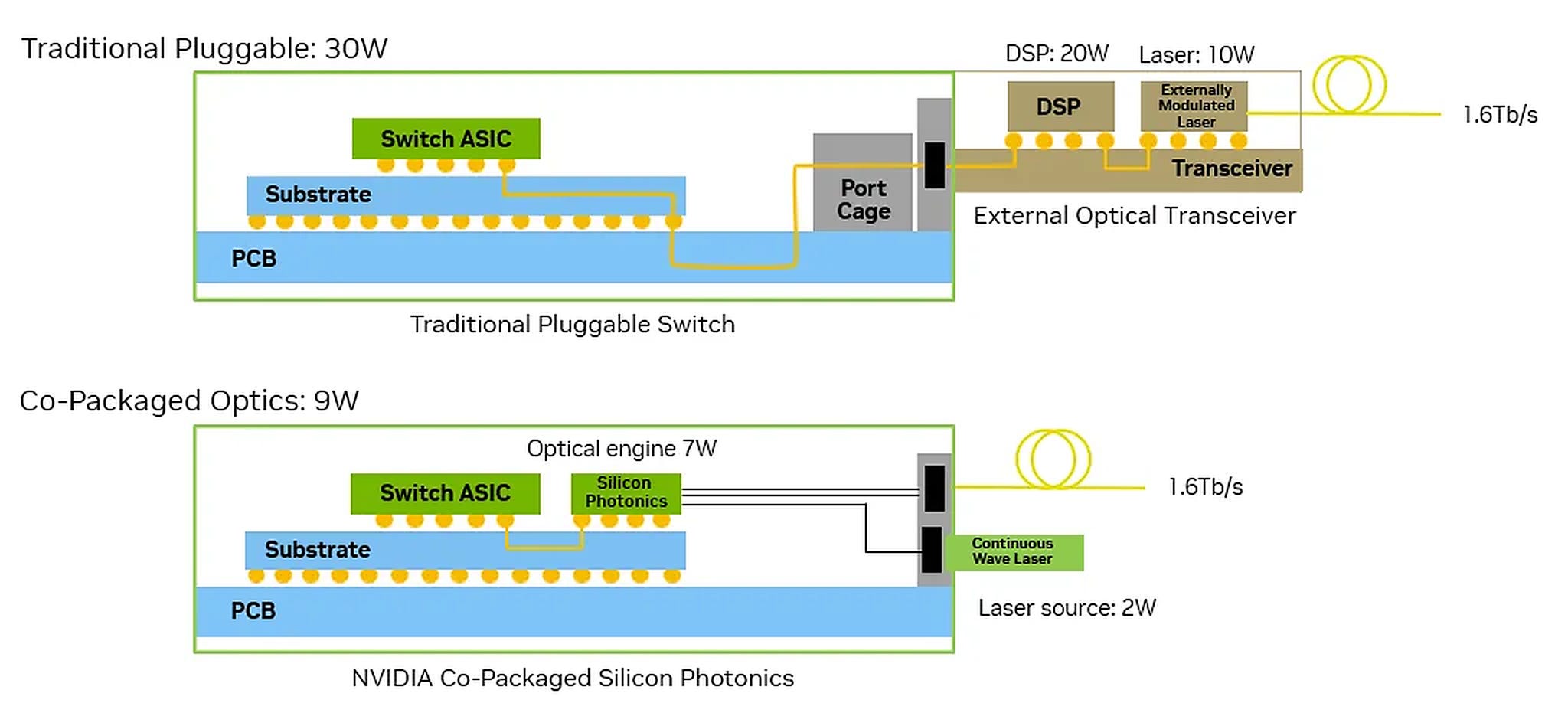
As I always say, in this power-constrained era, every watt saved is a watt that can be used for computation.
At this point, you should watch this Nvidia CPO video again, as it will make a lot of sense now:
Lasers and Silicon Photonics
Oh yeah, an important call out. Look at the Nvidia diagrams above again. The pluggable transceiver uses externally modulated lasers (EMLs) for 1.6Tb. These are discrete InP lasers + modulators.
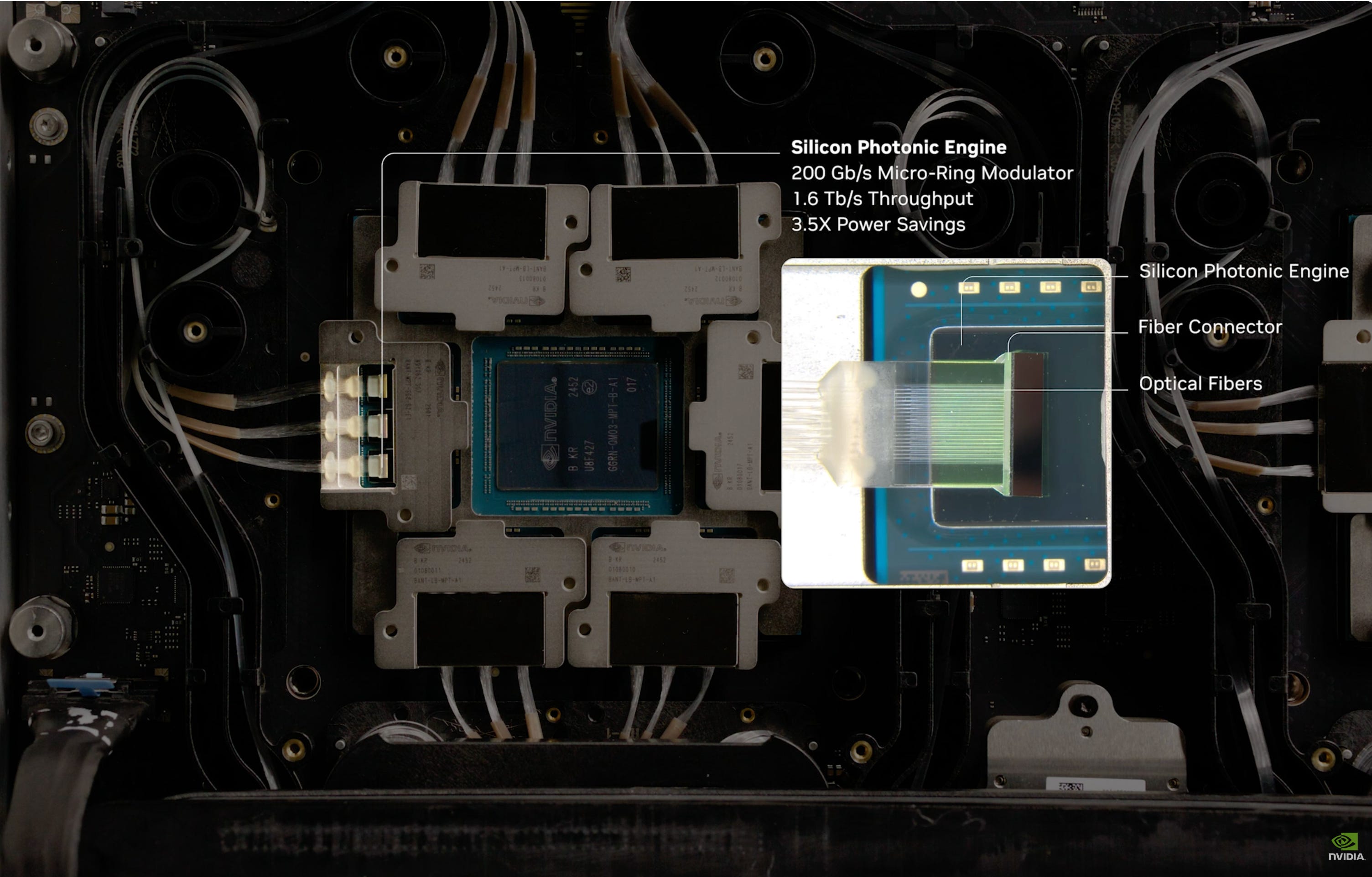
CPO uses lasers differently. Instead of modulating the laser itself, it uses a simple continuous wave (CW) laser (just a constant beam of light) and performs the modulation on a silicon photonics chip on the switch substrate:
Silicon photonics is an optical circuit built in silicon using CMOS-compatible fabrication of waveguides, modulators, photodetectors:
What about serviceability though? Don’t lasers fail?
Yes, and this was one of the earliest objections to CPO. In pluggable optics, a failed laser means swapping the transceiver module which is easy to access. But if the laser is near the switch… that’s a lot harder right?
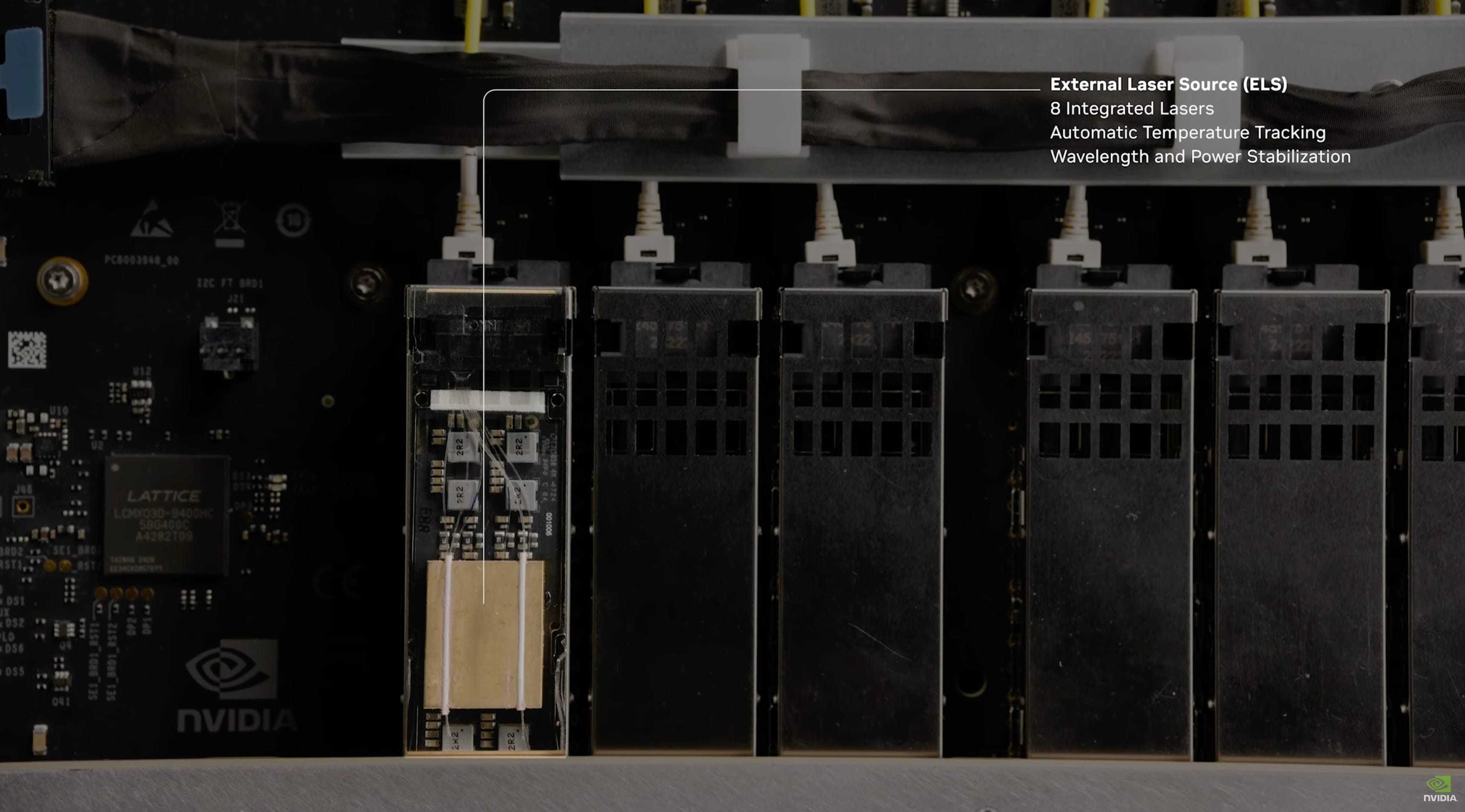
Well, don’t put the laser near the switch! The CW laser is external. So if it fails, you can still easily replace the laser source and not the switch.
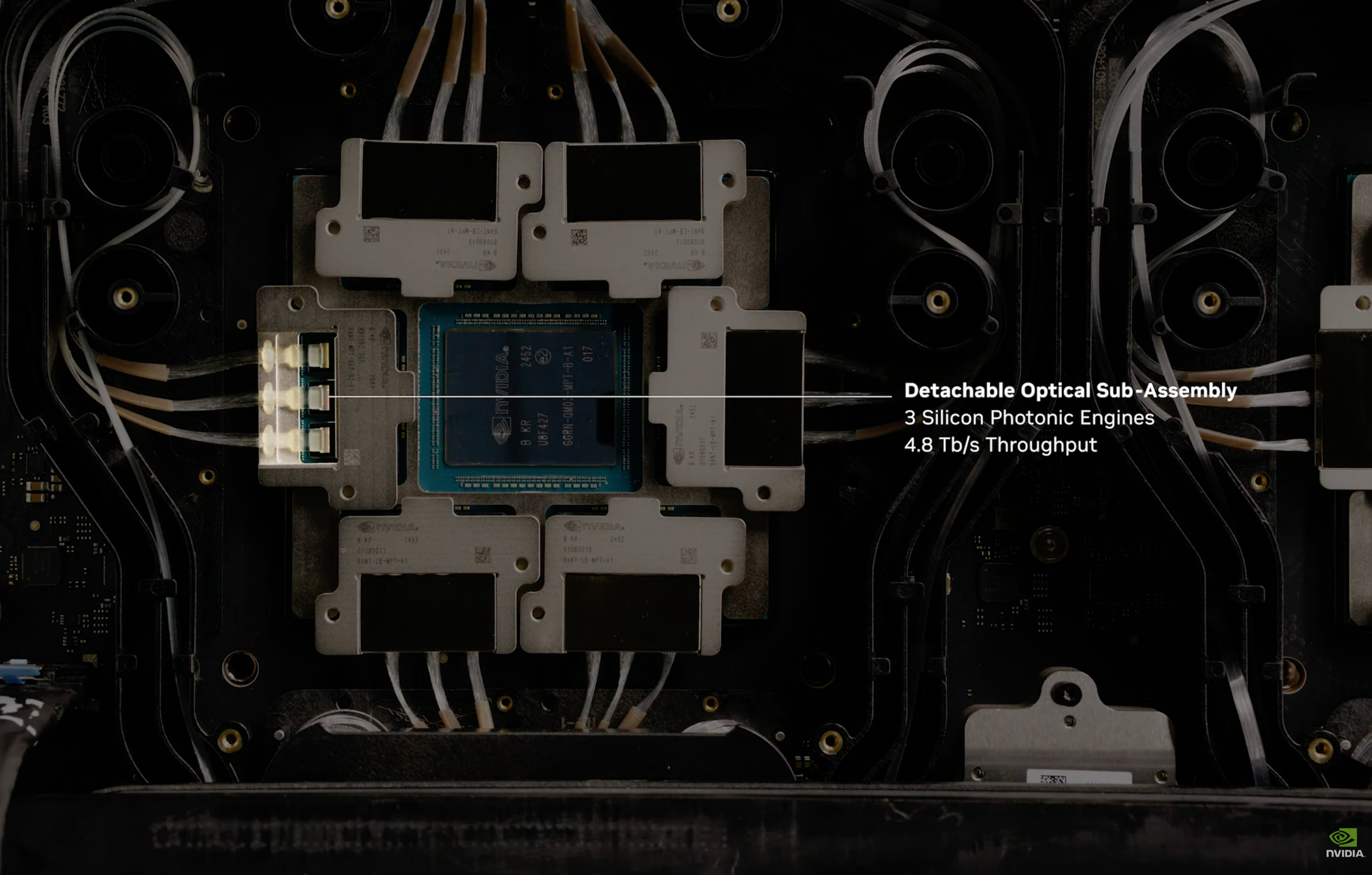
And as Nvidia shows here, the silicon photonic engines themselves are designed as detachable sub-assemblies. Not as easy as swapping a front-panel pluggable, but far better than scrapping the switch:
Thermal concerns are similar. Lasers are temperature-sensitive and switch ASICs run hot; pluggable EMLs combine a laser and modulator in a single InP device running at high speed, and they run hot and are among the more failure-prone components.
But with CPO, the laser is just a simple CW source and the high-speed modulation moves to silicon photonics. If the laser sits off-package, you’ve removed the most temperature-sensitive component from the equation!
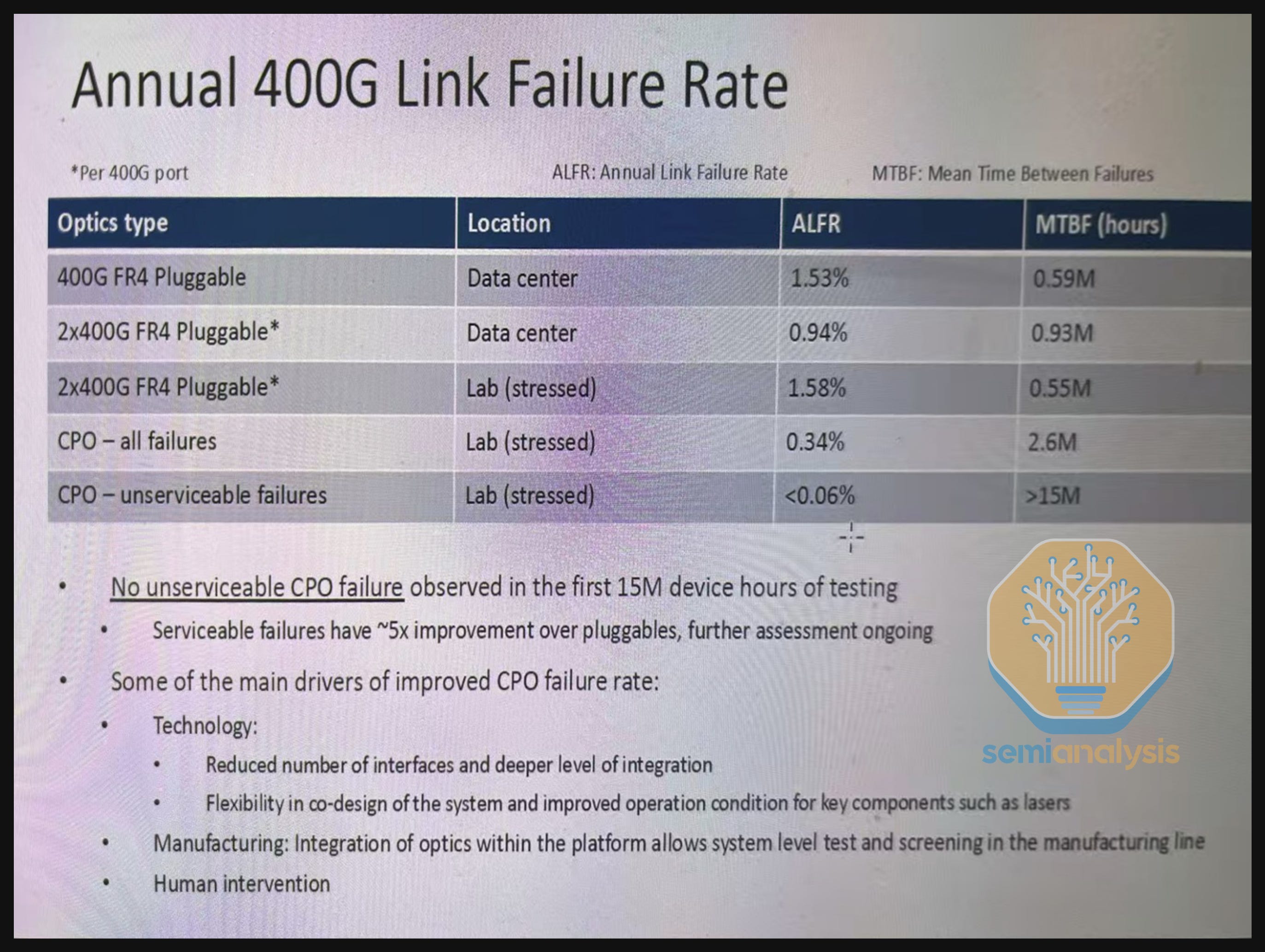
Moving optics closer to the switch looked like a reliability problem, but it may end up improving reliability instead. In fact, SemiAnalysis shared this nice slide from Meta that suggests Meta had fewer failures using CPO than with pluggables:
Trade-offs
Everything in engineering is about trade-offs, and CPO is no different.
Manufacturing is non-trivial. The silicon photonics engines sit very close to the switch ASIC, which means integrating optical and electrical components with different materials, process flows, and reliability characteristics. That complicates packaging, thermal design, and testing compared with traditional pluggable optics.
And CPO also tightens the coupling between the optics and the switch platform. With pluggables, operators can mix transceiver vendors or change optical reaches independently of the switch. In a CPO system, the optical engines are designed and qualified as part of the switch platform, which reduces that flexibility.
But that’s a manageable trade for hyperscalers, who co-design systems with their silicon partners (Broadcom, Marvell), control board layout and qualification, and deploy into environments they fully manage.
And Nvidia is bringing CPO to its merchant switch lineup (Spectrum-X Photonics, Quantum-X Photonics), which could eventually bring CPO within reach of non-hyperscalers who don’t have that kind of vertical integration. Well, they do have that kind of vertical integration… via Nvidia.
Pluggables Are Not Dead
Pluggable transceivers are EML-based InP modules with DSPs. As CPO scales, we need more silicon photonics engines and CW laser sources, and fewer DSP chips for pluggables.
People like to jump to conclusions. Remember: Copper is dead! Long live optical!
But as Vik and I discussed recently, I’d sum it up as: The answer is both. The question is when.
Yes, the direction of travel is toward tighter integration of optics and silicon. But the debate is how fast. After all, Hock Tan claimed 400G SerDes on the last Broadcom earnings call, which would extend the pluggable runway. But Broadcom is also shipping early-access CPO switches. Nvidia is shipping CPO in 2026. Marvell acquired Celestial AI to get in the game.
Today, pluggable optics concentrate value in the transceiver module. InP EML lasers, DSPs, driver and TIA chips, optical packaging. Companies like Lumentum, Coherent, Fabrinet, and DSP suppliers like Marvell and Broadcom sit in that value chain.
But with CPO, there’s an unbundling in the value chain. The optical functions move onto the switch package as silicon photonics engines, the laser becomes a separate CW source, and the DSP largely goes away.
Hence, value shifts toward silicon photonics, CW laser production, and advanced packaging, and away from standalone transceiver DSPs and pluggable module assembly.
But again, these shifts are happening over time. As I said in the video above, the transition between technologies isn’t just a binary thing on a particular date, but more of an adoption curve. Even a single hyperscaler can be deploying different technologies at different places at roughly the same time. So pluggables are still a great business.
I’ve already started pulling on these value chain threads. If you want to understand the laser side in depth, check out Lumentum and the Laser Bottleneck and Broadcom Makes Lasers, which are both directly connected to the CW laser and silicon photonics shifts we covered here. And more to come! Coherent, Applied Optoelectronics, Astera, Poet, etc. Getting lots of requests from readers :)
If you found this useful, subscribe. And if you want the deeper company-level analysis as CPO scales, consider going paid.