


After covering Lumentum’s lasers, I was planning to hit Coherent next... but a friend reached out and inspired me to sharpen up on Broadcom. So let’s do that together.
Most people hear Broadcom and think Tomahawk switches, XPUs, VMware, Hock Tan. Not lasers. But Broadcom has actually been the primary 200G EML supplier to date, given its position in Nvidia’s 1.6T transceivers. It turns out there’s an interesting history and a great hidden business here.
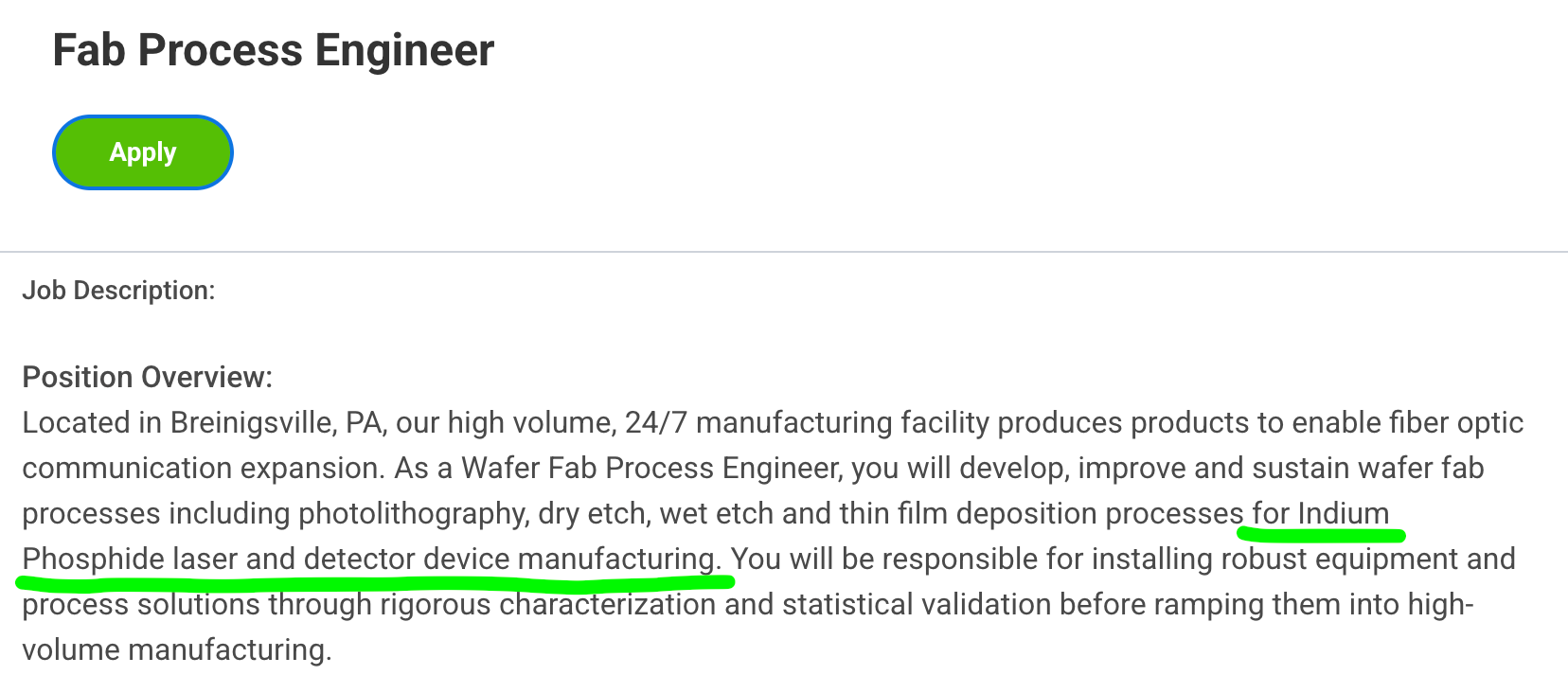
Heck, Broadcom owns the former Bell Labs InP fab in Breinigsville, Pennsylvania. And they are hiring!
So Broadcom makes its own EMLs, VCSELs, and CW lasers, and pairs them with the industry’s leading DSPs and switch ASICs.
I’m genuinely impressed.
That’s arguably the most complete photonics stack in the industry. I had no idea. Broadcom, you should tell this story!
Broadcom’s Laser Business
Digging in, the laser business looks great:
Total EML capacity is projected to grow from over 40 million units in 2025 to 50 million in 2026. This is across all speeds. 100G for 800G transceivers, 200G for 1.6T, and other applications
CW laser capacity is expanding from mid-teens millions in 2025 to roughly 30 million in 2026
Broadcom was first to ship high-volume 100G-per-lane EMLs and VCSEL technology
Management claims leadership in 200G EMLs for 1.6T transceivers
The networking segment, which includes these components, carries Broadcom’s highest margins outside of software
Note that Broadcom doesn’t break out its photonics revenue separately. They should! Lumentum trades at ~60x forward earnings as a pure-play laser company. Coherent trades at ~44x on vertical integration. Broadcom’s laser business... not sure how the Street values it. It’s buried inside a networking segment within a semiconductor solutions business unit. inside a $1.5T market cap conglomerate. Investors can’t price what they can’t see. I said this about Nvidia autonomy business recently too, and previously about the Nvidia networking business.
On the Q4 FY2025 earnings call, CEO Hock Tan said:
“The demand for our latest 1.6 terabit per second DSPs that enables optical interconnects for scale-out, particularly. It’s just very, very strong. And by extension, demand for the optical components like lasers, PIN diodes, just going nuts.”
Going nuts.
With EML capacity ramping 25% year-over-year and demand going nuts, photonics breakout would give the Street something to actually model in a sum-of-the-parts fashion. And Jefferies notes that Broadcom’s networking segment carries the highest margins outside software.
InP lasers are high-ASP, high-margin components, and the 100G-to-200G mix shift roughly doubles the ASP per laser. Vik and I over at Semi Doped have been very interested in exploring components companies with stacking s-curves, where each generation of new product has higher ASPs.
How does Broadcom’s laser position compare to Lumentum and Coherent?
Today I dug into the 1.6T competitive dynamics, CPO timeline, the substrate supply risk (and a good update this week from Lumentum derisking this substrate supply risk), and some bull/bear tensions.
Plus a three-way comparison between AVGO, LITE, and COHR during this optical supercycle.
Went down the rabbit hole over the past few days, thanks for coming along on the ride and learning with me!
Not financial advice. Do your own due diligence.