


The scale-up optics trade used to focus on the question “when does CPO displace copper?” But the times they are a-changin’, and this earnings season the industry is clearly articulating NPO as an intermediate step to CPO.
It’s coming up a lot on earnings calls. From GlobalFoundries:
Karl Ackerman, BNP Paribas: For my follow-up, if I may, could you discuss what portion of those 7 customers on your SCALE platform are working on NPO or near-packaged optics -- and I guess how should we think about the timing of your NPO opportunity?
Tim Breen, GF CEO: Yes. Maybe just to take a step back, and I think there’s obviously a year ago, the industry wasn’t talking a lot about NPO -- now it’s talking a lot about it.
Let me remind newer folks quick about NPO.
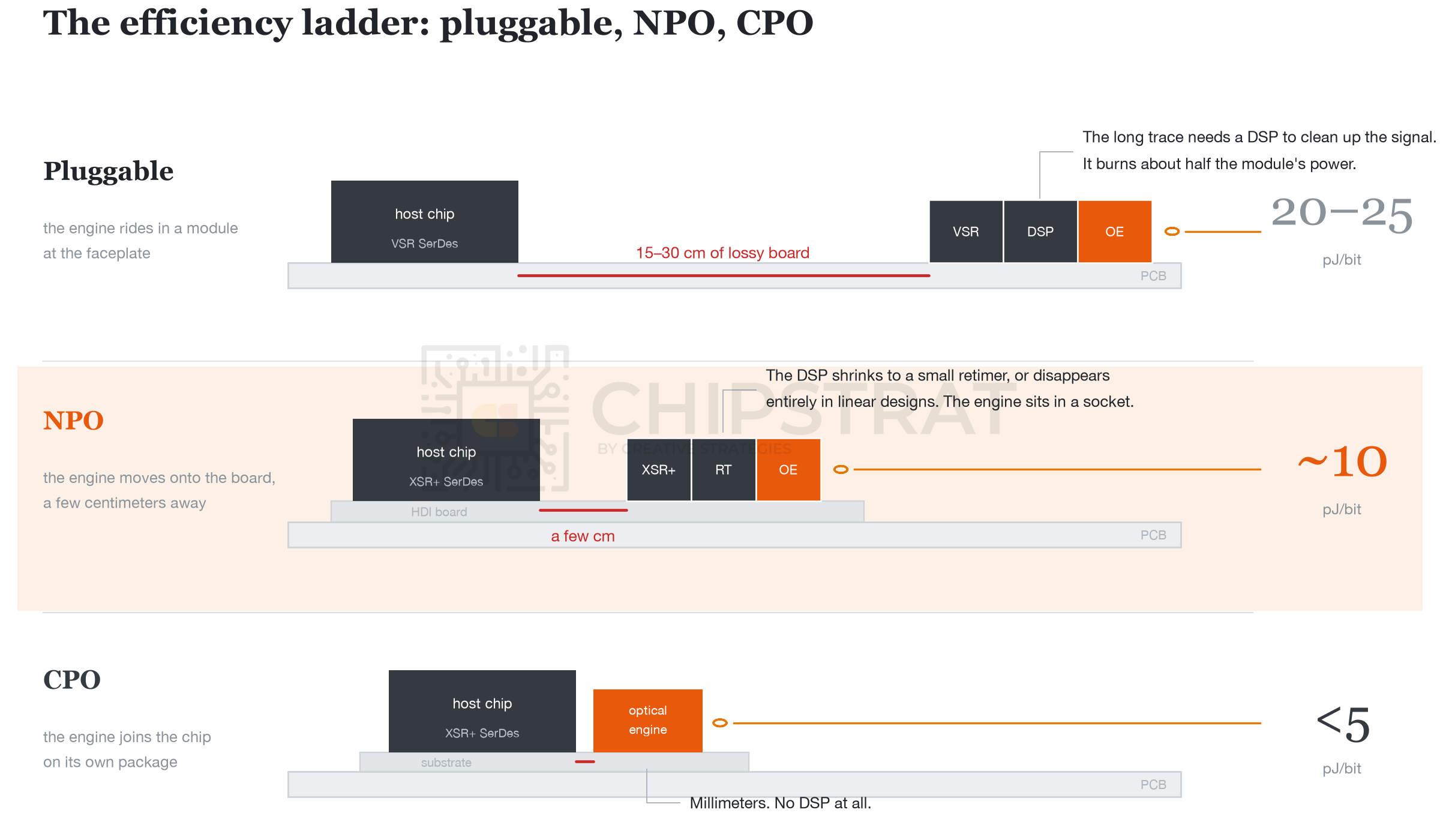
Today’s pluggable transceiver is the industry’s workhorse, but it burns a lot of power. The module connects at the switch faceplate (far from the switch chip), so a long copper trace on the board is needed. High-frequency signals over copper degrade, so a power-hungry digital signal processor (DSP) sits in the transceiver, cleaning up and retiming signals in both directions, transmit and receive.
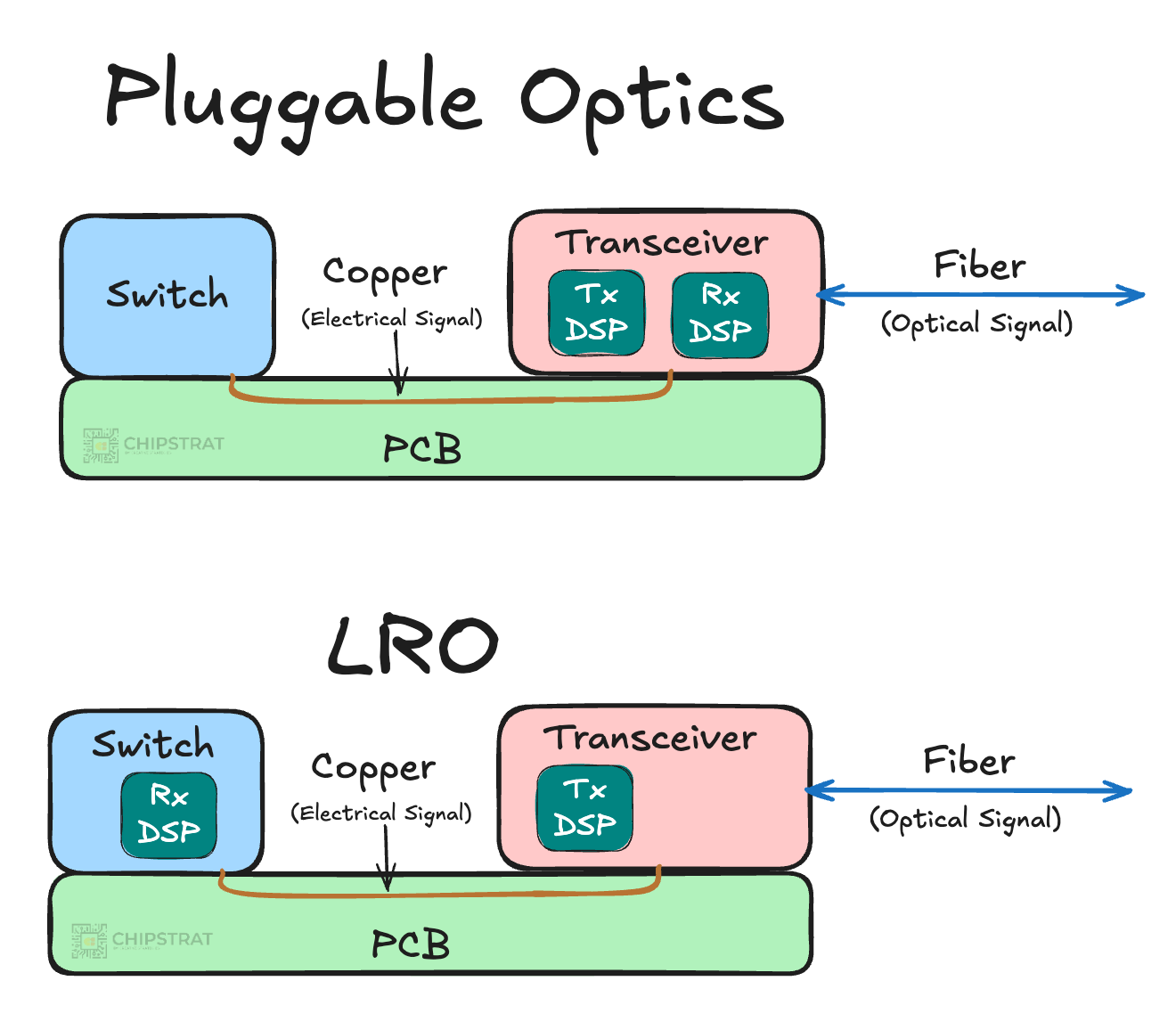
Linear optics such as LRO above give that cleanup work to the switch ASIC’s own SerDes. The transceiver can shed the DSP silicon (LRO sheds the receive half; LPO sheds all of it), and the power spent per transmitted bit drops.
Co-packaged optics take this to the logical conclusion and move the optical engine onto the chip’s own package.
NPO is the middle step. The optical engine moves onto the board a few centimeters from the chip, into a socket, but remains outside the package:
A nice two min video about this from my chat with Tom Barber:

So “What is NPO?” is one of the five Ws, and now you might now be wondering about the other four Ws:
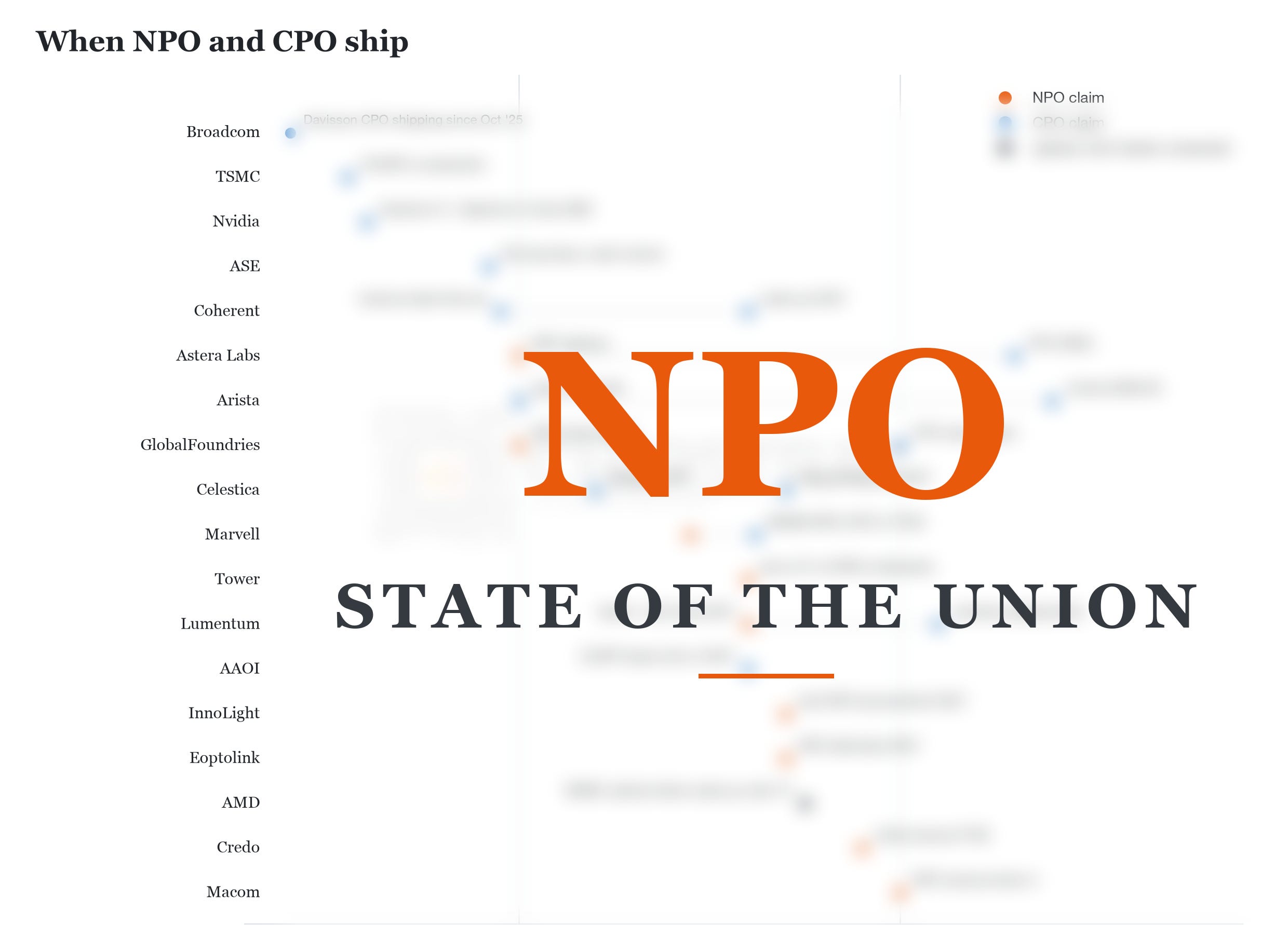
WHEN NPO?
WHERE NPO?
WHO NPO?
WHY NPO?
Well, more context.
Remember that the CPO switches in the news like Nvidia’s Quantum-X and Broadcom’s Davisson are CPO used in scale-out. And a quick reminder that scale-out doesn’t simply mean “rack-to-rack” and scale-up doesn’t simply mean “within a rack” as lots of folks tend to say online.
GPUs/XPUs/AI ASICs want to access each other’s memory so fast that the remote memory feels like their own. Accelerators on the same “scale-up domain” can do just that. They wish they had more HBM, but for now it’s just you get whatever is attached to your board and that’s it, so the hack is to access your neighbors as if it was your own. This landscape will change with HBM pooling btw, but that’s a topic for another day.
If accelerators aren’t on the same scale-up domain, then they communicate over the scale-out network.
Scale-up has historically lived within a server node first (e.g. just 8 GPUs in a scale-up domain) then within a rack (72 GPU domain). But the scale-up domain can span neighboring racks too! NVL576 connects eight racks of 72 Rubin Ultra GPUs into a single NVLink domain. We even see Kyber rack NVL1152 taking it to eight racks of 144 GPUs, with optical links between racks.
So the first CPO products are switches on the scale-out network. Not GPUs. The optical engine moves onto the switch substrate, and nothing changes on the GPU side; the endpoints still run pluggables and copper. This is just like the images above where the O/E is moving closer to switch ASIC.
OK, with that in mind, back to what the industry is saying about when, where, who and why.
We can see a shift in language from various industry participants; for example, back in February, Macom CEO Stephen Daly positioned Macom’s products as “optimized for co-packaged and highly integrated architectures, like CPO and NPO”. Ah ok, both NPO and CPO are a-comin’
In May the prepared remarks carried the same script line in different words, and it was the only CPO mention in the call. By August, the line read “highly integrated architectures like NPO and XPO”. What? Where is CPO? And XPO?! And that call also mentioned NPO nine times. Macom now talks about NPO and XPO, not CPO.
This raises follow-on questions.
When is NPO ramping? And why didn’t this NPO-before-CPO come up sooner?
Does NPO push CPO back entirely, or only in certain sockets?
Who benefits from NPO? Who doesn’t?
How much of the “CPO” shipping today is actually NPO? Is marketing at hand here?
Is NPO accretive or cannibalistic? For whom?
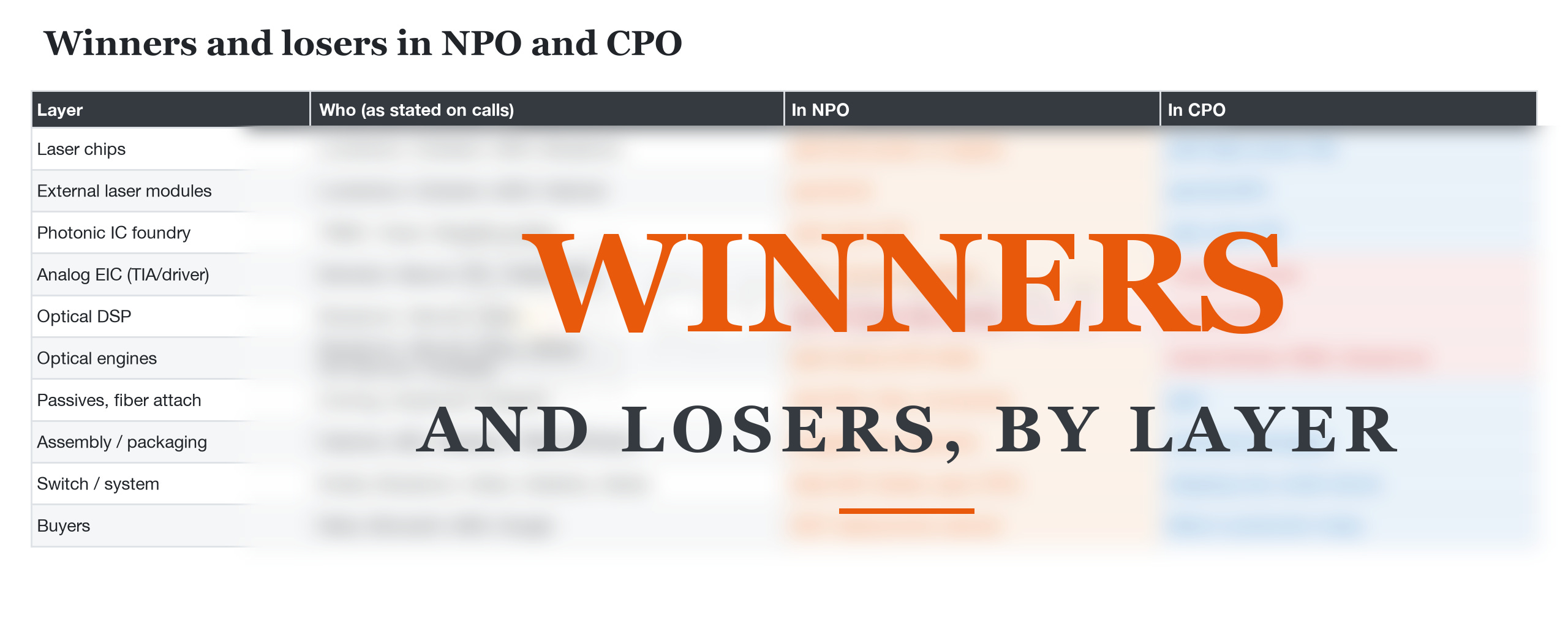
We’ll answer those below for subscribers.
We’ll also unpack the related MSAs and what they tell us.
We’ll touch on many companies including GlobalFoundries, TSMC, Tower, Lumentum, Coherent, AAOI, Macom, Semtech, Credo, Astera Labs, Marvell, Nvidia, AMD, Broadcom, Arista, Ciena, ASE, Celestica, Fabrinet, InnoLight, Eoptolink, HG Genuine.