


We got a big surprise yesterday after the market closed. AMD agreed to acquire Taalas, a 25-person chip startup in Toronto.
I was pumped to see it. This is right up my alley! It’s AI accelerator startups + a strategy puzzle of sorts... and requires us to get into the technical nitty-gritty a bit. Does it matter to AMD’s competitiveness? Stock price?
Taalas builds what it calls model-specific silicon. Rather than loading weights from memory into a programmable accelerator, it hard-codes a specific model’s weights directly into the chip as read-only memory. The result is fast, cheap, and completely inflexible. Which is the point! Its first chip, the HC1, runs Llama 3.1 8B and nothing else. And that’s the point...
Also note the HC1 is referred to as just a tech demonstration.
Btw, Bajic spent 10 years at AMD, then later co-founded Tenstorrent and ran it as CEO and CTO before starting Taalas in 2023.
So AMD paid an undisclosed amount for a company with no revenue, no named customers, and one chip that runs one open-weight model. But weight wait! The idea has merit once you dig into it!!!
Let’s unpack it.
If you’re new here, skim this useful background from the Chipstrat archive so you can follow the narrative arc:
The Rise of Groq: Slow, then Fast (Jun 2024). How an SRAM-based accelerator found its market, and why ultra-fast inference turned out to be a business rather than a demo.
Right Tool for the Job (Dec 2025). Why Nvidia bought Groq to fill an ultra-low-latency gap in its portfolio.
The Multi-Silicon Era Is Here (Mar 2026). Nvidia formally embracing disaggregation, and what it opens up for multi-vendor datacenters.
Right Systems for Agentic Workloads (Jan 2026). Why low-latency accelerators and long-context accelerators are different machines.
Right-Sized AI Infrastructure. Marvell XPUs. (Oct 2025). Right-sizing infrastructure per workload instead of buying one monolithic platform.
The overarching question we’ll attack: does this change how we should perceive AMD’s competitiveness? And it ultimately comes down to whether you believe ultra-high interactivity is a real and profitable product tier. Jensen does....
Of course the whole story is a bit juicy too. Recently at Advancing AI (July 23rd), AMD announced a partnership with Cerebras that is also a very-fast-tokens play. But then AMD agreed to buy Taalas fourteen days later!? What to make of that?
Let’s talk through:
Why agents want fast tokens
The interactivity revenue curve
Why GPUs can’t get to high interactivity
What Taalas is
🔐 Speculative ways to use Taalas.
🔐 The IP AMD is buying
🔐 The semi-custom inference cluster
🔐 How much context actually fits in HC1
🔐 Enterprise and edge?
🔐 What this means for Cerebras
🔐 So is AMD cheap here?
Interactivity is a product tier, and it has a premium price
Remember when Groq CEO Jonathan Ross did the real-time LLM demo on CNN on Valentine’s Day in 2024? That was awesome. Demo is like 2 minutes into the video. Watch to the end.
Real-time voice was a fun demo and shows the power of super-low-latency tokens. But agents are the reason the fast token market is blossoming.
In the chatbot days, humans were the bottleneck; we can only read and interact so fast. But agents operate much faster! And as a result, they generate way more tokens. And even though the machine will run for days, of course we humans still want to see all that agentic work done in a reasonable time.
To illustrate, a 50-step agent chain generating 500 tokens per step is 25,000 tokens of sequential work. At 200 tokens per second per user, that’s roughly two minutes. But at 1,200 tps that’s only ~20 seconds. And at 12,000 tps, it’s ~2 seconds. Which one commands a premium? Not the slow two minutes of tokens...
To pique your interest, Taalas claims 16,960 tokens per second for a particular use case!
Nvidia says customers will pay a lot for fast tokens
Look at Nvidia’s modeling of the value of fast tokens:
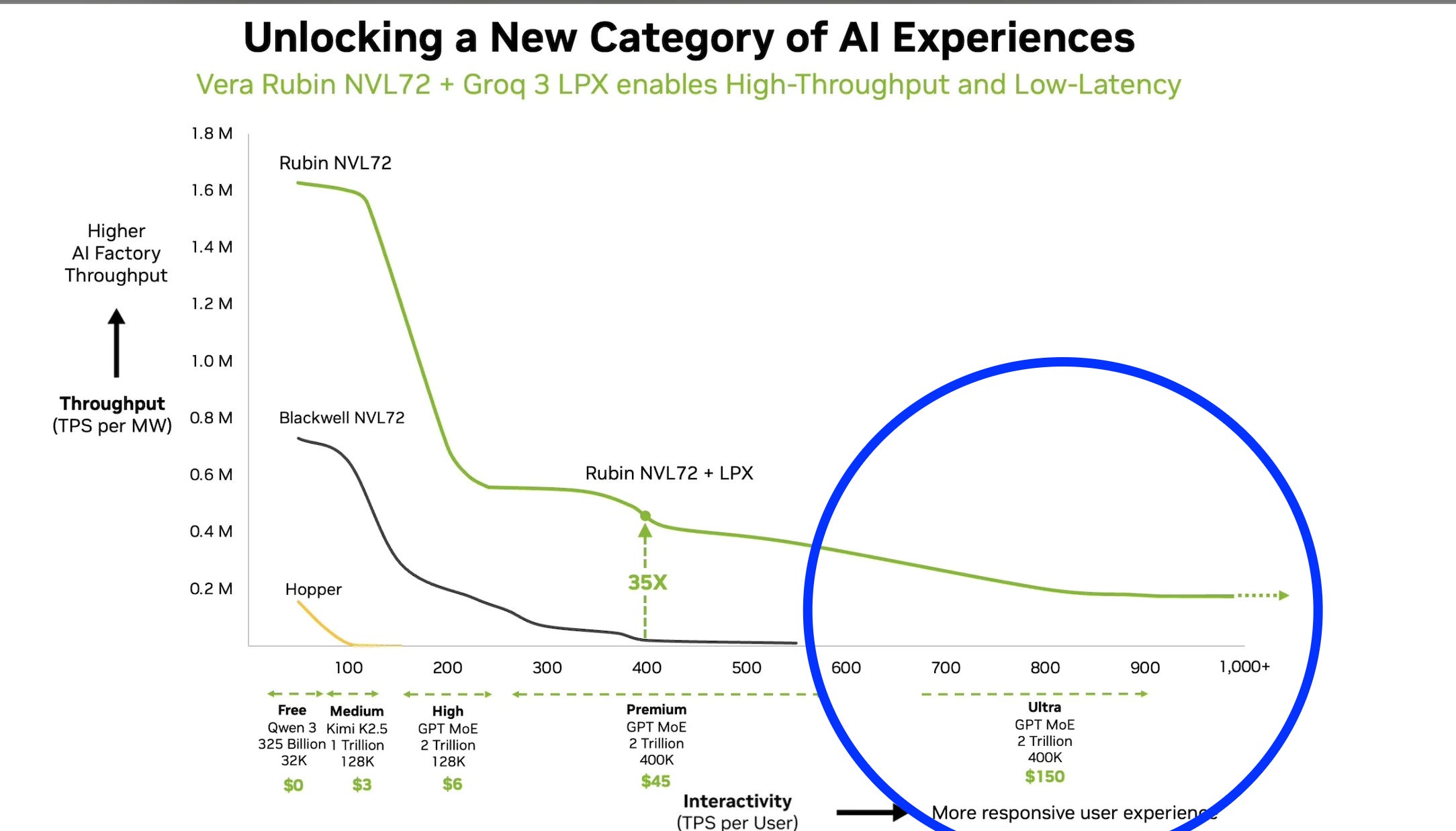
The x-axis is interactivity aka tokens per second per user. Faster is better.
Notice Nvidia shows five service tiers of sorts in dollars per million tokens.
Free $0. Medium $3. High $6. Premium $45. Ultra $150.
So the same million tokens sells for 25x more at the Ultra tier than at High.
That’s the premium for speed!
So why isn’t everyone selling Ultra tier tokens? Because GPUs can’t get there.
Blackwell NVL72, in all its liquid-cooled, state-of-the-art scale-up domain glory, can’t hit 600+ tokens per second per user. It. just. can’t.
GPUs can’t do super fast tokens
Why? Communication latency. Collectives latency.
Recall that decode is memory-bound; every token means streaming the activated weights plus the KV cache out of HBM before doing a little math on it. Of course, useful models don’t generally fit on a single GPU’s HBM, so we shard it across more GPUs.
Tensor parallelism helps here, since each GPU reads a slice of every matrix and you get that bandwidth back in parallel. The tradeoff is latency, because now the GPUs have to talk back and forth for every layer, every token.
Take a big MoE like DeepSeek-V3 at 671B parameters. Its config tells us it’s 61 layers, with the first 3 dense, so 58 MoE layers, 256 routed experts, 8 active per token.
Tensor parallelism requires at least one all-reduce per layer. Then each MoE layer adds two all-to-alls on top; one to dispatch each token to its experts and one to gather the results back. That’s something like 116 all-to-alls plus 61 all-reduces, so call it ~175 collectives per token. Don’t forget that a collective means all the GPUs wait for the slowest one to respond...hence needing low jitter…
So how long does it take a collective to process? Measured small-message collectives over NVLink land in the single-digit microseconds, roughly 4 to 9 µs depending on the protocol.
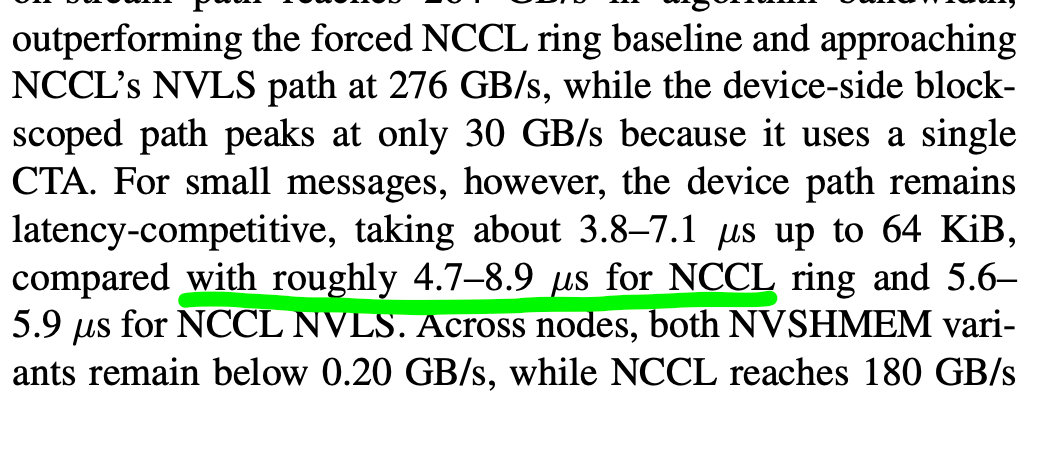
So 175 collectives at 4 µs is ~700 µs per token. And that’s just the GPUs talking to each other… before any math happens.
Granted, engines overlap some of this with compute, but a collective requires synchronization between all GPUs so there’s a floor on how much you can overlap.
To be fair, this is single-user decode napkin math and tricks like speculative decode improve interactivity. But still, there are limits to a GPU-only path unlocking the “Ultra” tier above.
Well then, what to do?
Nvidia showed the way. Prefill on Vera Rubin NVL72 and part of decode on Groq’s SRAM-based LPUs.
(See more in Right Tool for the Job and The Multi-Silicon Era Is Here. Disaggregation makes this possible.)
Which unlocks that blue circle:
Yet AMD’s pareto curve would be like the Blackwell NVL72 curve. It would stop short of the blue circle.
So AMD addressed that. But not with a $20B deal like Nvidia. Rather, a partnership, a disaggregated system with Cerebras: Helios does prefill, the Wafer-Scale Engine does decode.
Why not buy Cerebras? AMD doesn’t have that kind of money, and Cerebras is public and too expensive anyway. And maybe there’s better long term solutions anyway…
But then fourteen days later AMD announced an agreement to buy Taalas!
What Taalas is
Taalas came out of stealth in February 2026 with the HC1.
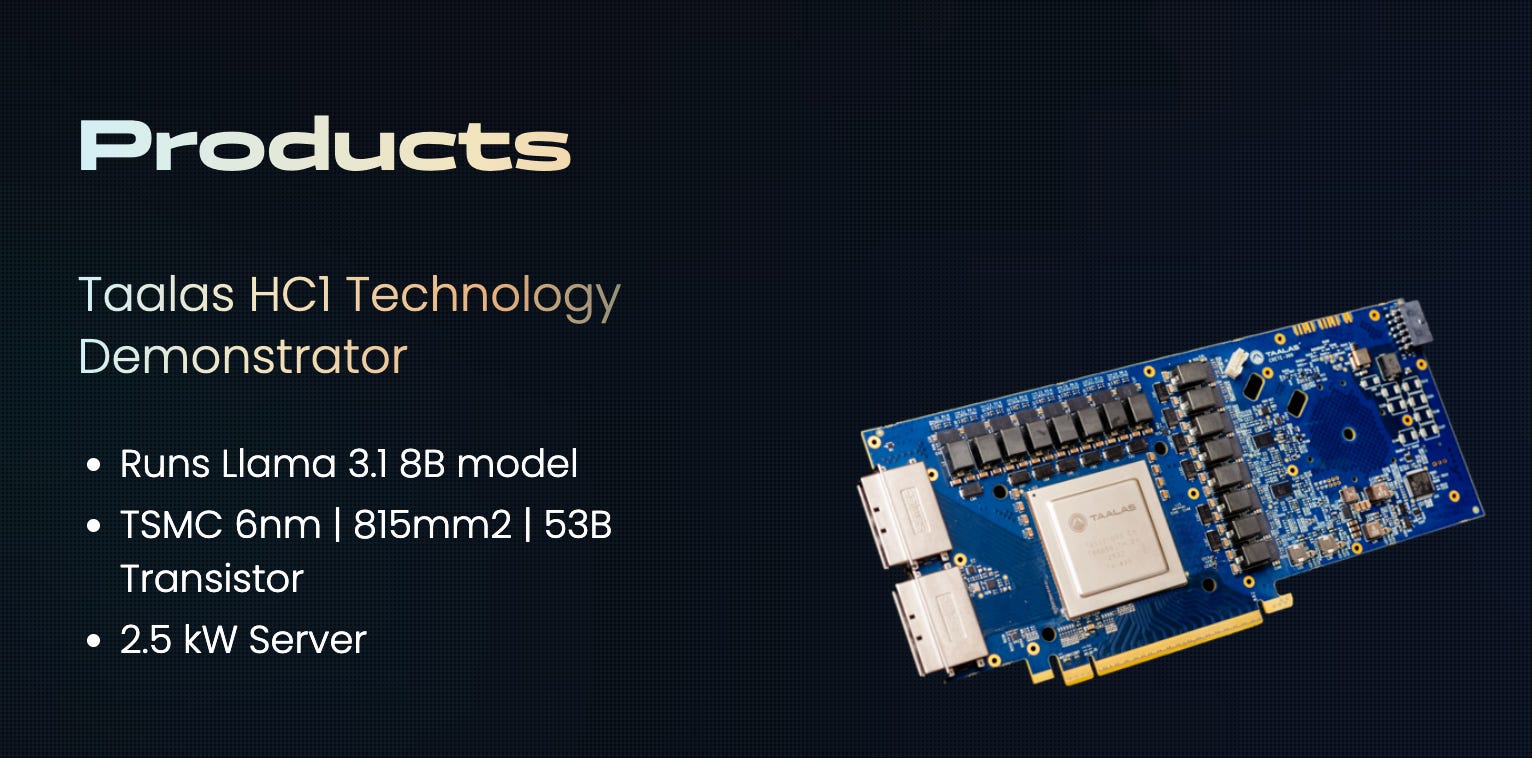
TSMC N6, 815 mm², 53 billion transistors, and no HBM or external DRAM. Everything the chip needs sits on the die. Sounds good when memory prices are so dang high right?
The model weights live in a mask-ROM recall fabric burned into the silicon. A smaller SRAM holds the KV cache and any fine-tuned weights. Hmm, what about long contexts?
No advanced packaging either. No CoWoS bottlenecks. Cheaper.
About 250W in a PCIe card, in racks that draw 12 to 15 kW and run on air. Deploy anywhere.
It runs Llama 3.1 8B. Hmm, edge model? Draft model? Hmm…
Changing models means changing two mask layers, which carry both the weights and the dataflow, on a two-month turnaround.
The idea stems from earlier tech. From Sally’s article:
Taalas is borrowing some ideas from the structured ASICs of the early 2000s to make its hardwired model-specific chips. Structured ASICs used gate arrays and hardened IP blocks, changing only the interconnect layers to adapt the chip to a specific workload. At the time, this was seen as a more cost-effective alternative to a full-custom ASIC that was more performant than an FPGA.
“There are definitely parallels,” Bajic said. “It’s a similar idea to eASIC and gate arrays, but the underlying technology looks really different.”
Of course, the eye-candy: 16,960 tokens per second per user at 0.75 cents per million tokens. OK! That’s FAST!
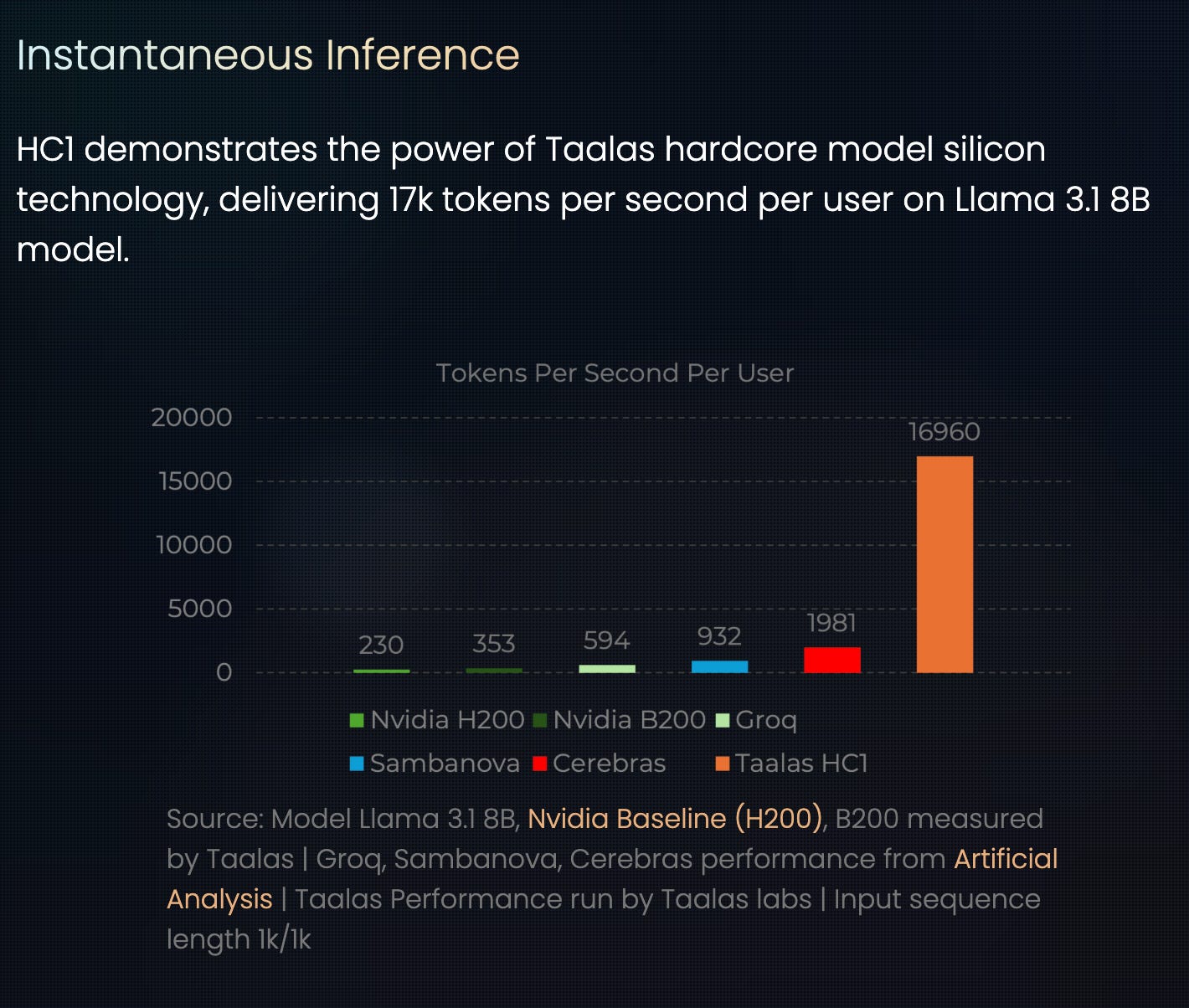
Of course the figure is self-reported, the model is quantized “aggressively” by Taalas’s own description, and the benchmark point is 1k/1k input/output. That’s small input/output, an important detail, we’ll dig into it below.
The customers? Bajic from EETimes:
“The big thing at the root of this idea is the assumption that the customer is willing to commit to this [chip/model] for a year. There will definitely be a lot of people who won’t, but some people will.”
Did you notice how Nvidia’s chart with our blue circle, it topped out at 1,000 tokens per second per user and put $150 on that tier? Taalas claims 17K tokens per second on an 8B model at 0.75 cents per million tokens. How much is that worth? Well, there are lots of asterisks.
So is Taalas a Cerebras replacement, or something else?
Is there a job an 8B chip does better than anything else on the market?
What about long contexts? Is this dead-on-arrival?
What about AFD?
Hmm, did AMD buy a product, or a hiring pipeline?
And does any of this change what AMD is worth today?
Let’s get into it.