


TSMC had a great quarter. But some things stood out. For example, TSMC says AI demand is unbounded. Why, then, doesn’t CapEx match that sentiment?
In the pandemic-era supercycle, TSMC spent 53% of revenue on CapEx. In the AI supercycle, with roughly $100 billion a year of operating cash flow, they’re spending only 34-36%:
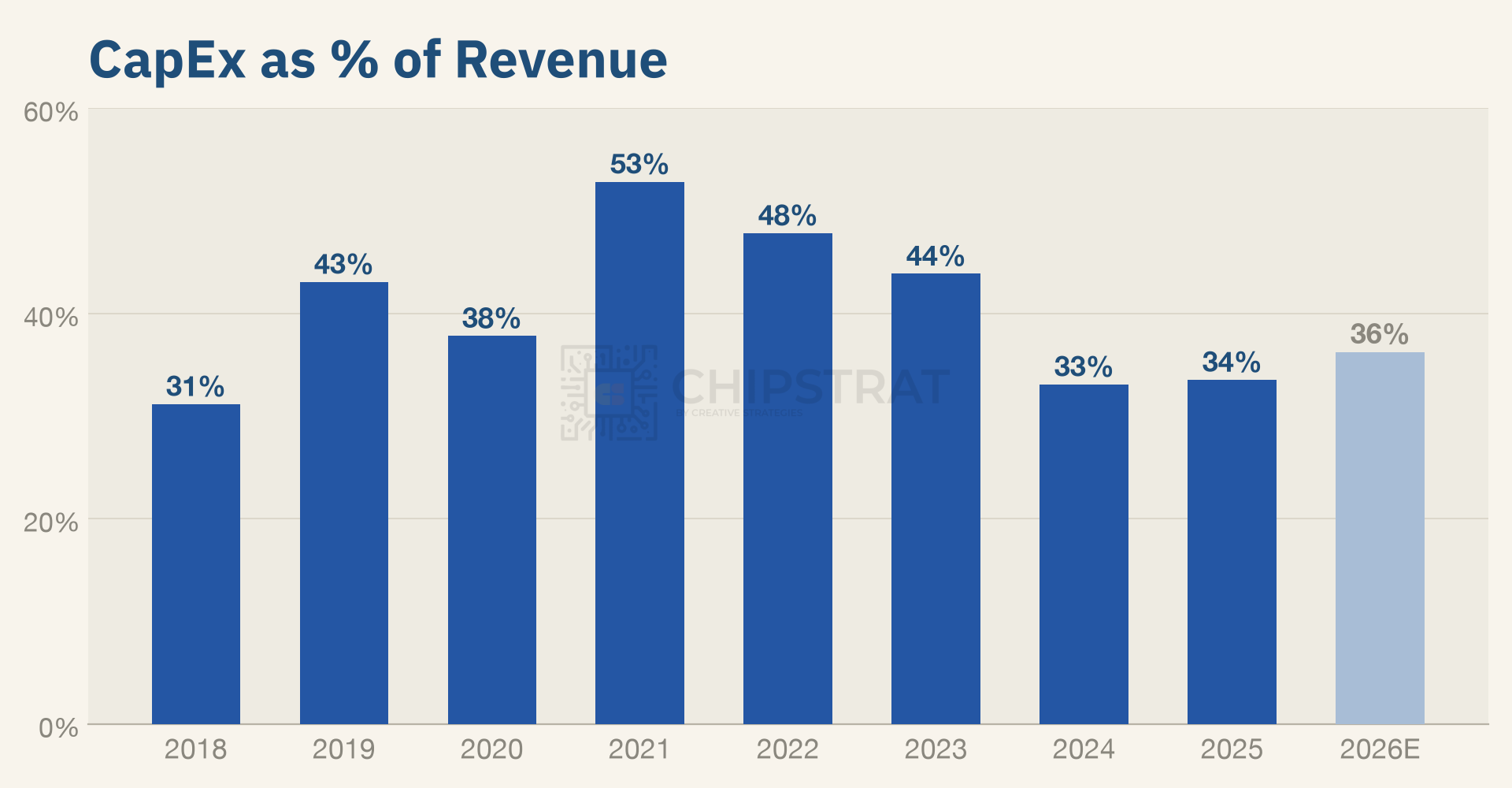
Matching the 2021 playbook today would mean another $30 billion a year. What to make of that?
Maybe TSMC got burned by 2021-2023 and ~35% is the preferred comfort level for management. Or it could be a lack of faith in the long-term demand?
TSMC has arguably the best ability to ascertain true demand given the breadth of customers, and talking to customers’ customers... So why aren’t they investing more? What did Wei see?! ... jk
Let’s pull out a few interesting questions from TSMC’s great quarter.
What’s in this piece
N2 has arrived
Gross margin peaks, gross profit keeps growing
🔐 Digging into the CapEx gap
🔐 What happens if they underinvest
🔐 Pricing… no talk, but it’s in the margins
🔐 What to watch going forward
N2 has arrived!
N2 debuted at 3% of wafer revenue this quarter:
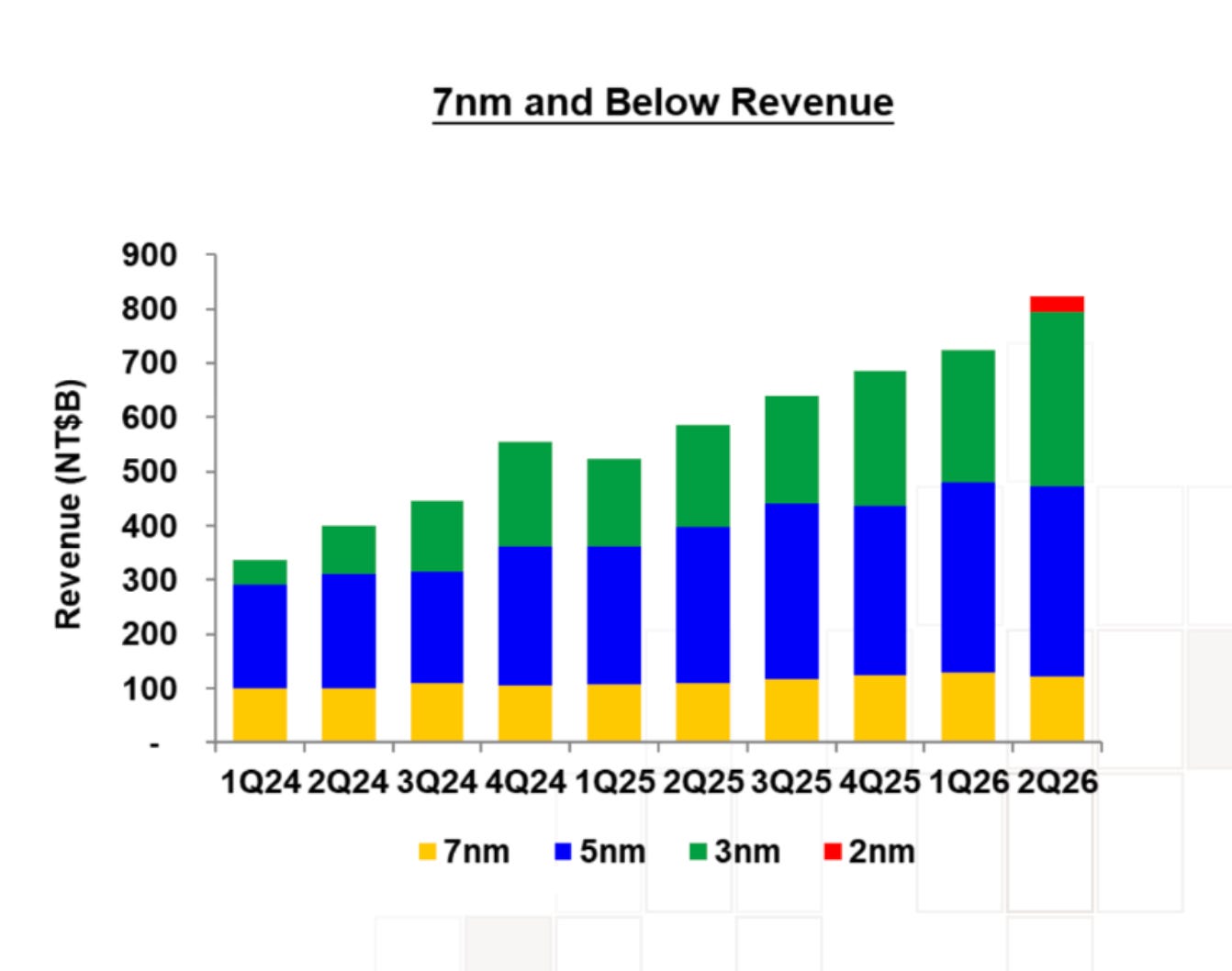
Only 3%? Look at that baby little red bar in 2Q26... But interestingly every node debuts at about a billion dollars of revenue:
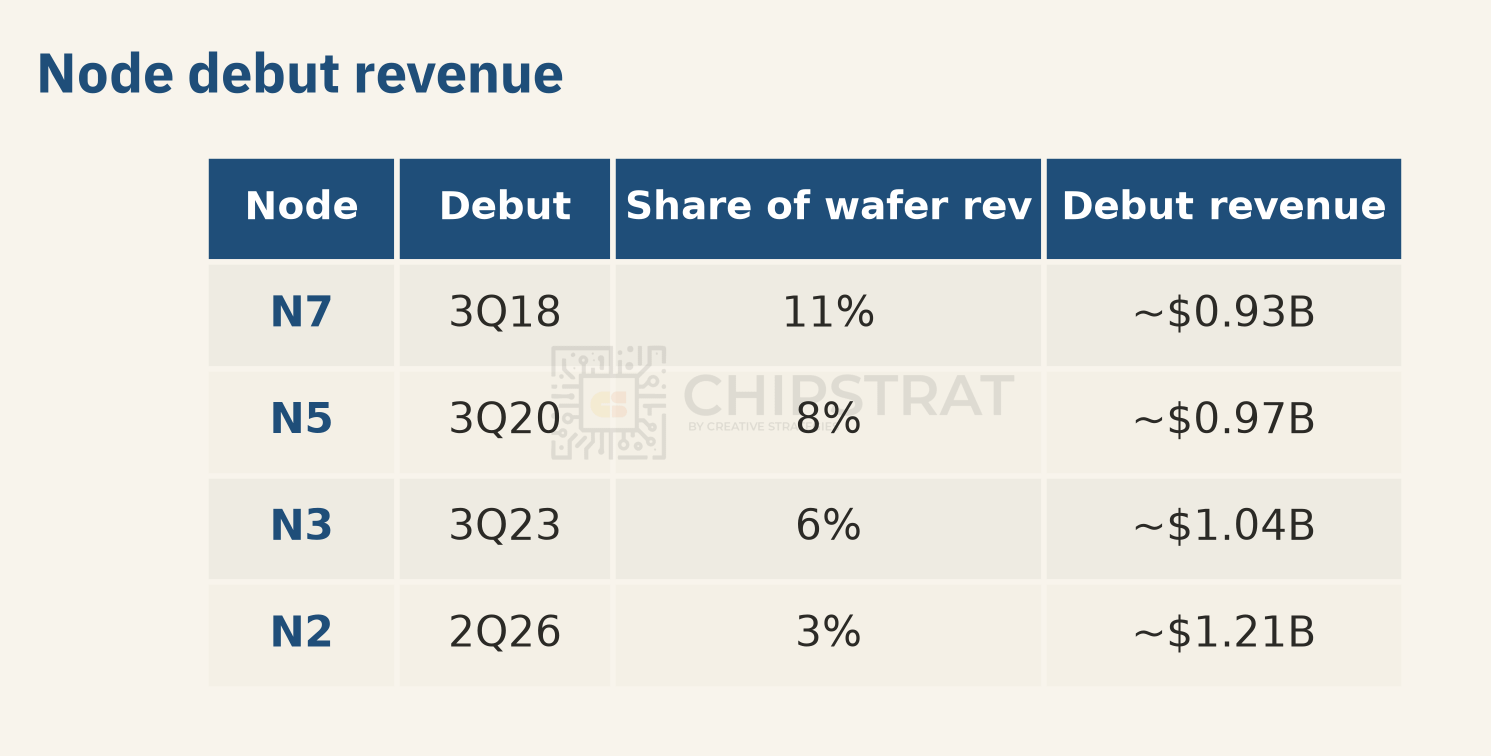
Mix share shrinks because TSMC’s revenue keeps growing.
Given that wafer prices rise every generation, flat debut dollars implies shrinking debut volume (wafer prices are rough, just for illustration):
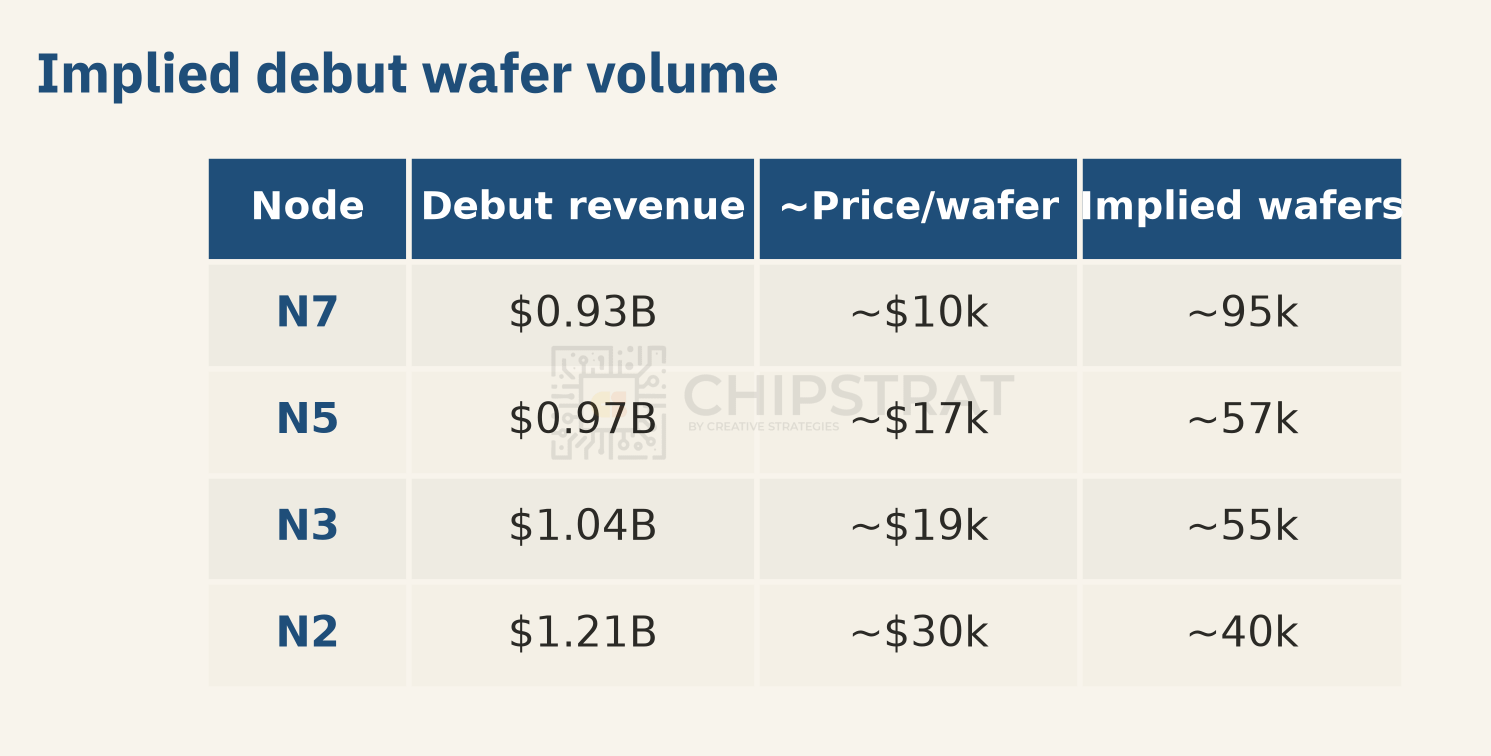
Volume shrinks because each new node has more layers and longer cycle times, so the same capacity ships fewer wafers in its first ninety days.
So N2’s debut is the fewest, most expensive wafers TSMC has ever sold. Customers pay the highest price per wafer ever, and these wafers cost TSMC the most to make, with yields still climbing and a new fab’s depreciation spread over small volume.
Interestingly, N5 is still the biggest node in the portfolio (33%), even though it’s six years old:
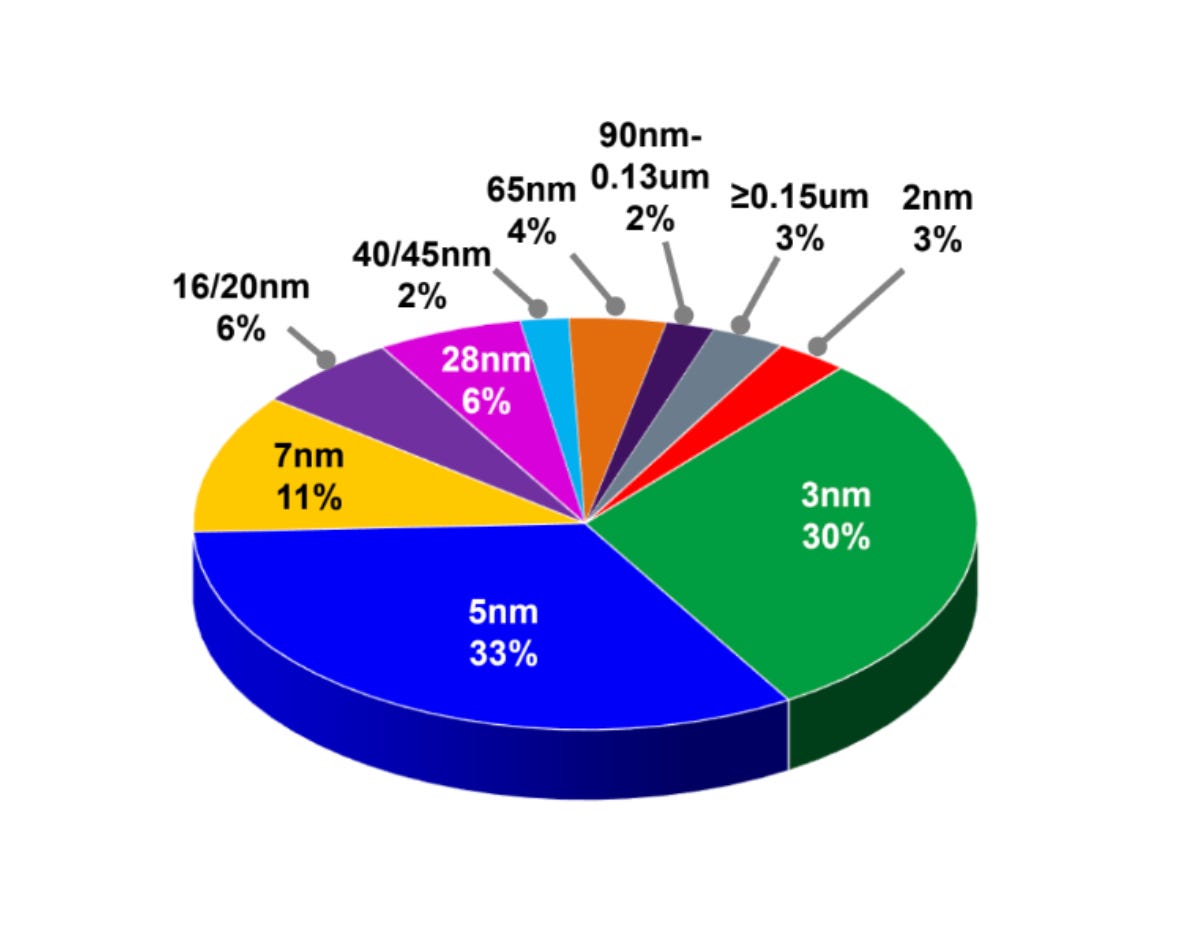
Why is such an old node still so dominant? AI. The answer is always AI. 😂
N5 is the AI node. Chips ship on whatever node was mature when they were designed two or three years earlier, and today’s AI fleet (Blackwell on N4P, Google’s TPUs, Trainium, most custom XPUs) was designed in 2022-24, when N5 was the obvious choice for big dies needing proven yield.
It’s interesting how long each node family hangs on:
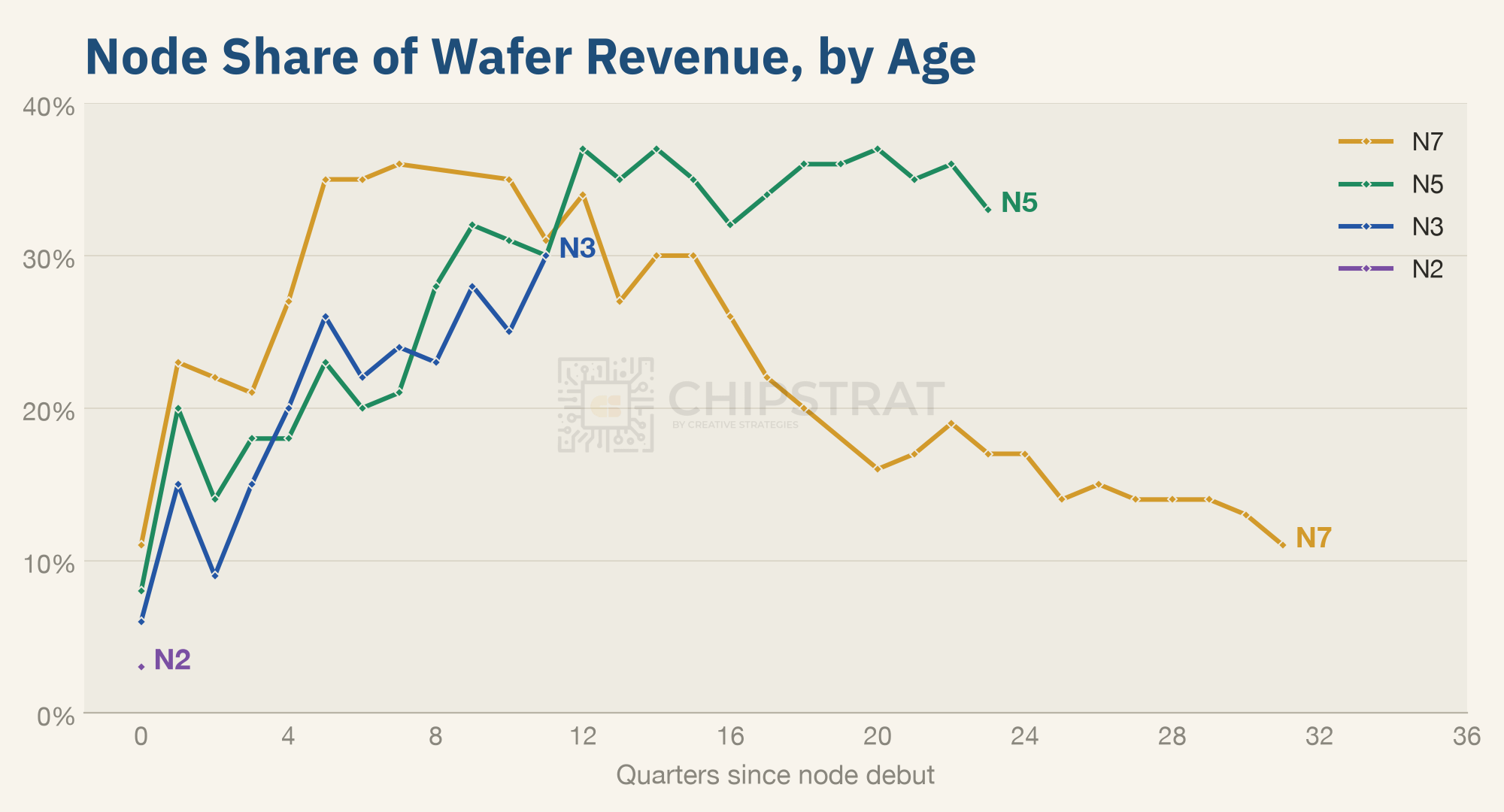
Of course, TSMC’s “5nm” node isn’t one process, it’s a node family. N5, then N5P, N4, N4P, N4X. So what’s six years old and 33% is the family, not the original process.
On this earnings call, C.C. said A14 will be “an even larger and long-lasting node for TSMC than N2, just like a 2-nanometer technology is a larger and longer-lasting node than 3-nanometer”. Each node is a decade-long product line, each bigger than the last.
Rubin-class accelerators move to N3 through 2027, hence N3 getting three new fabs. TSMC even approved three greenfield fabs for N3, a four-year-old node. One in Taiwan, one in Arizona, one in Japan. New fabs for kind of old nodes.
The longer a node family hangs on, the better the margins. N3 is “very tight,” its gross margin set to “cross over to the corporate average in second half 2026”, and its 2022 tools depreciate off in 2027 (equipment runs on a five-year schedule). Sold out, above average, depreciation-free.
Given that fabs are a ten-year+ asset, today’s CapEx is TSMC’s opinion on demand for the next decade...
Gross margin peaks, gross profit keeps growing
Gross margin printed 67.7%, a fifth straight record. But Q3 is guided down to 66.0%.
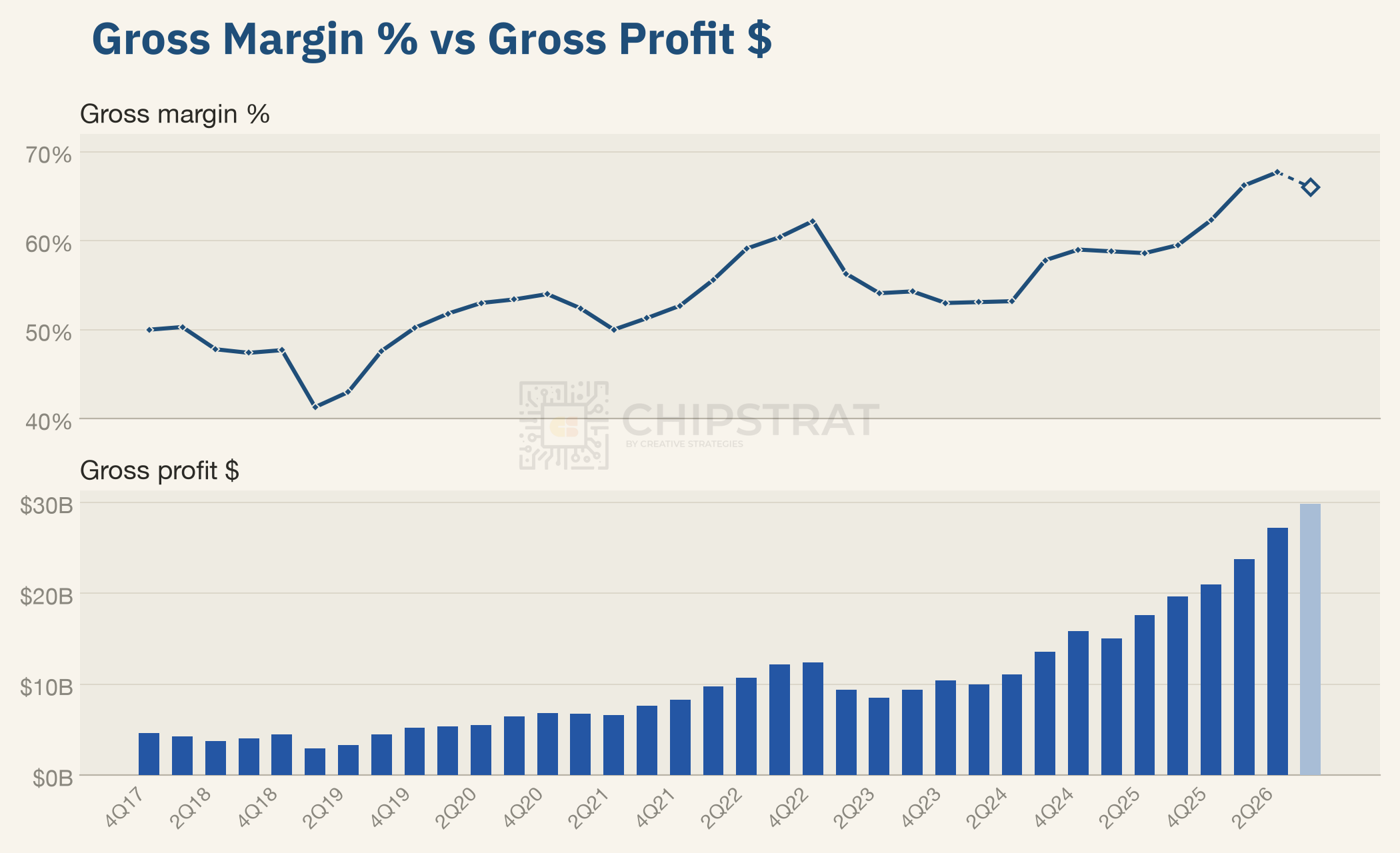
Reminds me of an MBA professor that I had, who told our class you bank profit dollars, not margin percentages. i.e. don’t sweat the margins too much
And the dollars keep climbing. Gross profit was roughly $27.2 billion this quarter; the Q3 guide implies about $29.8 billion. Annualized, that’s about $120 billion a year of gross profit.
Why the margin decline? N2 ramp. TSMC guided Q3 margin down “primarily as we expect the steep ramp-up of our 2-nanometer technology to dilute our gross margin by about 3 to 4 percentage points”. That’s worse than the 2 to 3 points guided in April, because the ramp got steeper. But steep ramp and more dilution sooner means more premium wafers sooner! So it’s fine.
The 67.7% gross margin might be the high-water mark until roughly 2028. Through 2027 there’s more margin drag as N2 dilutes for about eight quarters, A16 ramps behind it, and Arizona Fab 2 arrives 2H27. But if Q3 prints margins above 66.5%, well then, it would mean N2 pricing is covering its own ramp. One way to get pricing hints...
The last margin peak, 62.2% in 4Q22, was largely an FX bump at a cyclical top, and it stood for eleven quarters because demand then collapsed and margins fell. This peak is different! It comes from loading a new node as fast as physically possible while demand is spiking. So we’ll see another little mountaintop on the margins chart, but for an opposite and much better cause.
What paid subscribers get in the rest of this piece
First we’ll digging into the CapEx gap to figure out how much they could invest but aren’t. Then we’ll talk through the implications of TSMC underinvesting.
Also, pricing… TSMC doesn’t credit it to margins verbally, but it’s there. We dig in.
And what to watch going forward.
Thoughts, numbers and charts. Carry on: