


Synopsys had a lot to say about the future of AI and EDA at last week’s Investor Day in NYC. And I have a lot of thoughts on it myself after attending!
As Stephen Nellis reported for Reuters:
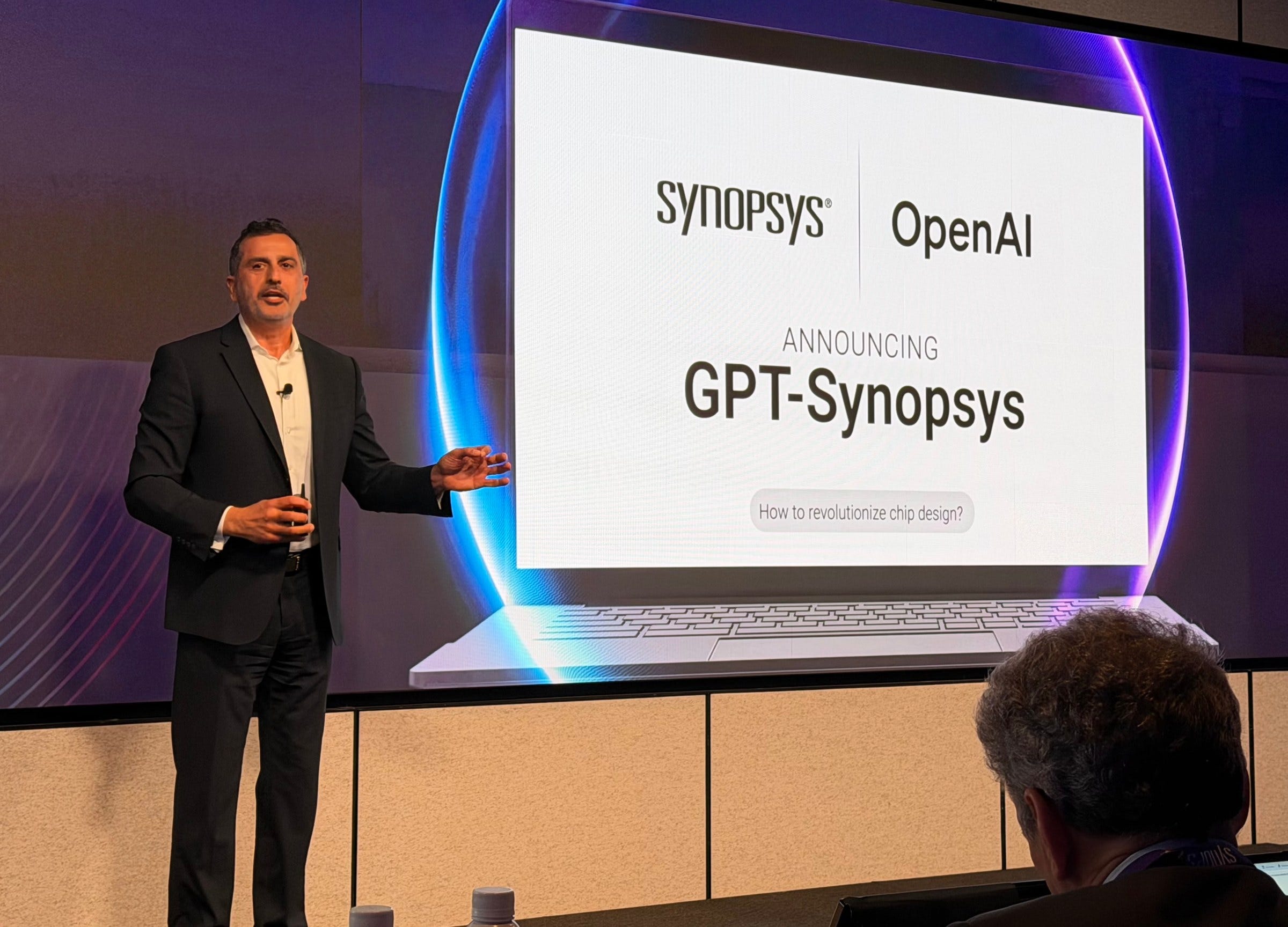
Synopsys, a maker of software used in designing computing chips, said on Wednesday that it has struck a deal to share revenue with OpenAI as the two develop an AI model for the chip business.
GPT-Synopsys, as the model will be called, will be specifically trained and tuned to take on chip design tasks, which start with a description of the chip’s circuits in a code-like language and span to determining how to lay out billions of transistors on a small square of silicon...
Ghazi told Reuters in an interview that OpenAI will pay Synopsys a training subscription fee for learning to use Synopsys tools. When Synopsys customers use the product, Synopsys and OpenAI will share revenue based on how well the model improves the design of a chip.
“We structured the agreement in a way that it will not be cannibalizing our business,” Ghazi said. “It will be an upside to our business given we’re delivering more value to the customer.”
Hmmm... is EDA not dead? I could have sworn everyone was saying the model labs were going to eat EDA’s lunch, because EDA is “just software” and OpenAI’s Jalapeño showed the death of EDA? Right?
Enough FUD, let’s work through this ourselves.
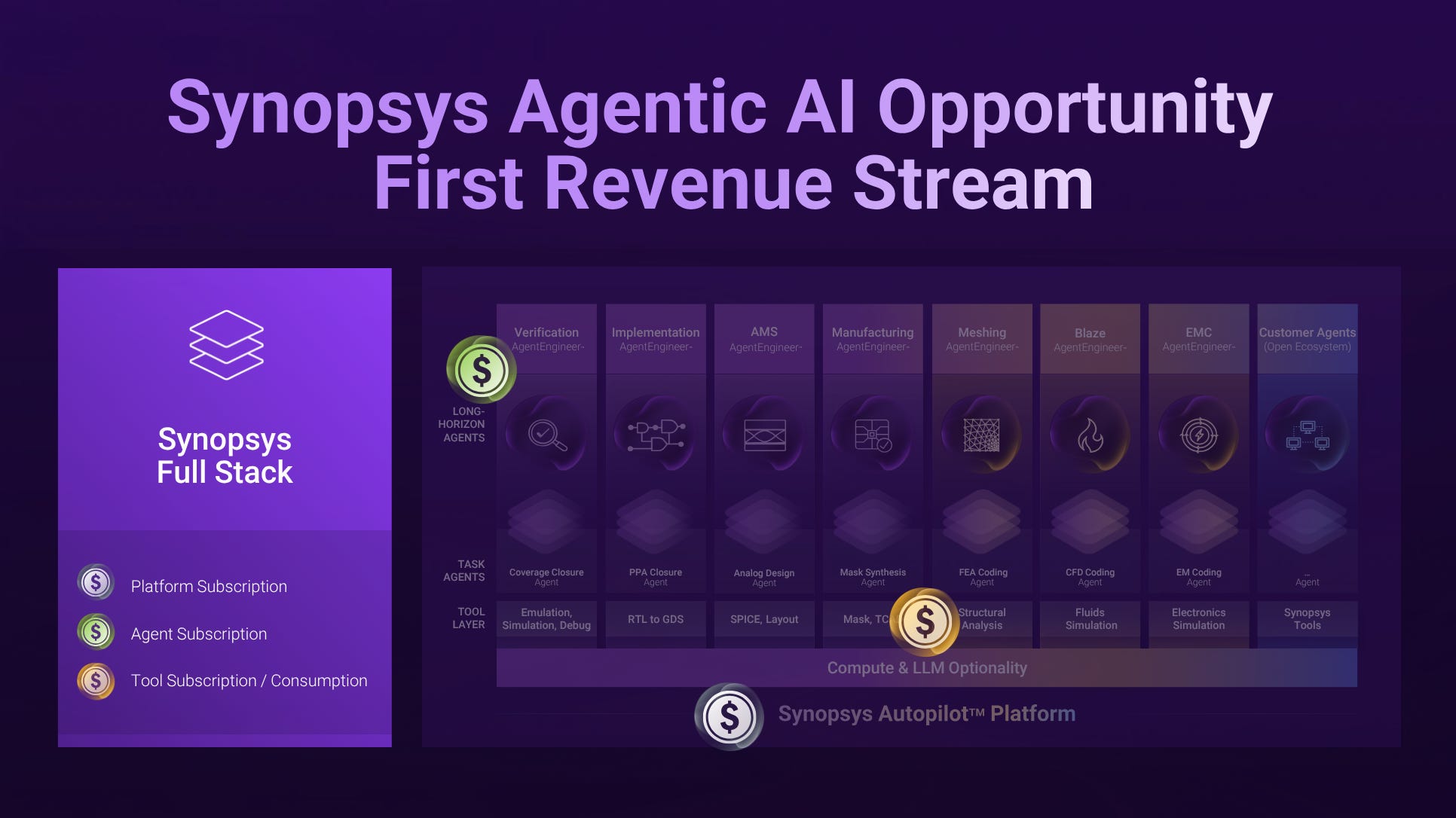
First, let’s discuss how Synopsys positions agentic AI with respect to Synopsys’ EDA tools. Here’s the portfolio slide from Investor Day:
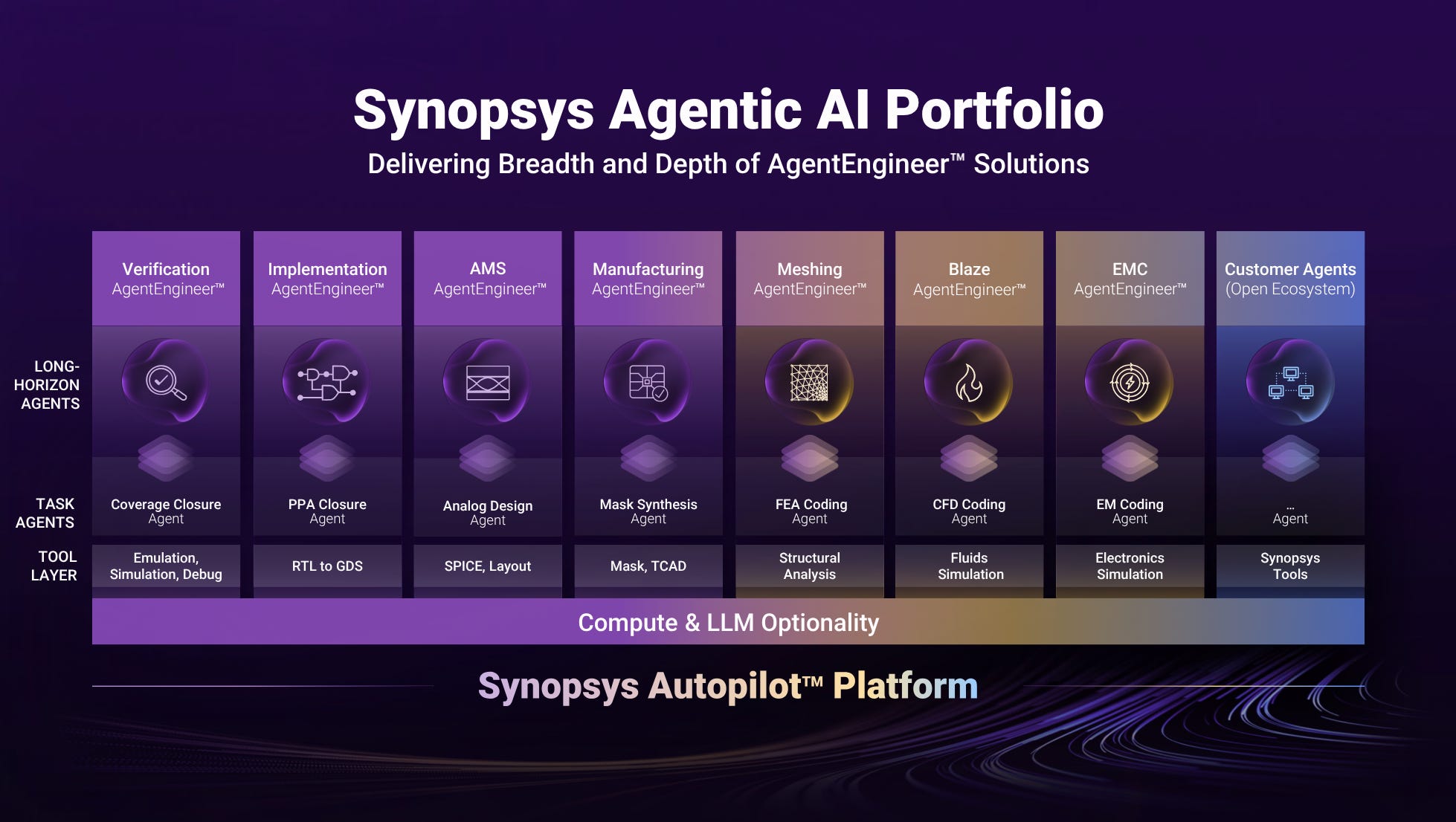
Importantly, the foundation is the tool layer, i.e. the existing EDA tools like VCS/Verdi, RTL-to-GDS, SPICE, Mask/TCAD, and Ansys physics simulation tools on the S&A side.
One layer above this are task agents, i.e. narrow jobs like Coverage Closure agent, PPA Closure agent, Analog Design agent, and so on.
Atop this are long-horizon agents which take an objective, decompose it, and orchestrate task agents + tools.
“A verification agent engineer is able to take an outcome or an objective, like here is a spec 200, 300, 500 pages long, and give me a verified RTL and test benches compared to the spec. Or here is a design that I’m trying to improve the coverage on, and I have about 30%, 40% coverage. Take this and make this into a 90% coverage situation.”
Shankar Krishnamoorthy, Chief Product Development Officer
As an analogy, if you use Claude Code or Codex for software vibe-coding, the tool layer is using git for version control or curl to hit an API; these are the lower level tools.
One layer up are skills that package the instructions and scripts for a particular job, like a skill to “bump this dependency and fix whatever breaks” or “write a database migration”. The skill knows which commands to run and how to check the output.
And at the top is the long-running agent that takes an outcome like “upgrade this app to the new version of its web framework”, and it plans the steps, calls the skills and tools, runs the test suite, fixes what fails, and keeps going until the tests pass.
Synopsys’ stack is the hardware equivalent concept.
Of course there are differences… including the business model. git and curl are free, whereas Synopsys’ tools are licensed. Are there incentives to create free open-source tool alternatives in that foundation layer? Hold that thought.
Synopsys pointed out that agents enable parallel exploration. Why not have several task agents each using a tool to explore the state space in parallel? Better outcomes for the customer (explore more solutions), and more tool use (license revenue) for Synopsys:
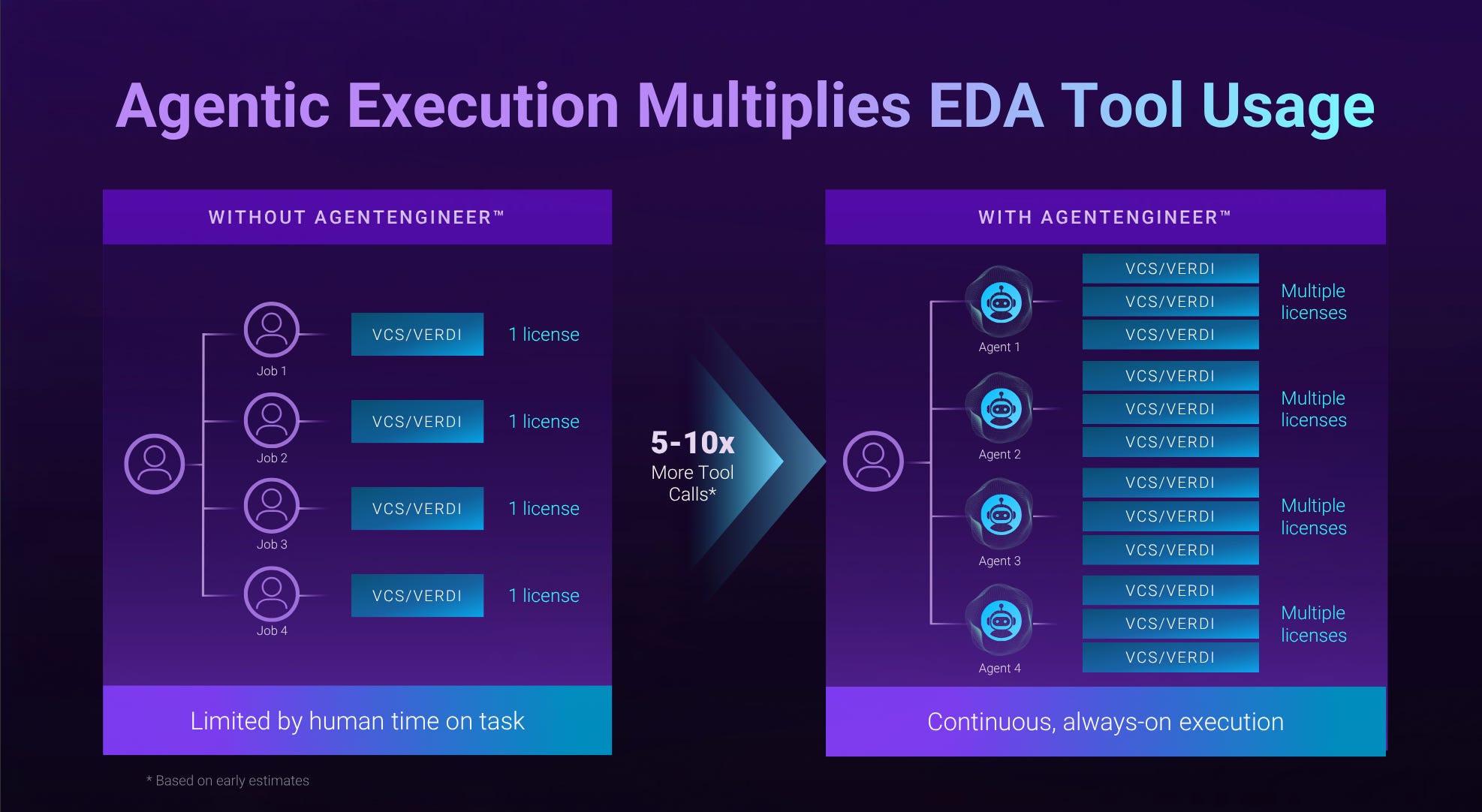
“The total work that can be accomplished is gated by the amount of human cycles that are available... you’re only gated by the compute on the right-hand side. The more compute you have, the more exploration, the more agents that can run in parallel”
Shankar Krishnamoorthy
That’s pretty awesome. Solution space exploration is definitely limited by the number of engineers on a team, which can’t easily scale up; but agents can!
But wait... what about OpenAI and Jalapeño using AI? Recall that OpenAI says AI helped take Jalapeño, its first custom inference chip, “from initial design to tapeout in nine months”… was that replacing Synopsys? Or was OpenAI scaling up it’s use of Synopsys?
At Investor Day, Synopsys CEO Sassine Ghazi pointed out Jalapeño still ran through Synopsys EDA, then Broadcom as back-end ASIC partner:
“when Jalapeño was announced, there was this simplistic extrapolation that if a model can build software, therefore the model can build a Fusion Compiler or a PrimeSim or VCS, and EDA is doomed... That simplistic extrapolation cannot be more far off than reality” — Sassine Ghazi
“The model needs these guardrails in order to check the physics”
— Sassine Ghazi, to Reuters
Ah ok, so OpenAI was running AI during front-end design, and mostly at the task/agent layer, not the tool layer and seemingly not during back-end design (Broadcom).
But could the tool layer be replaced by AI too? If not, why not? Hold that thought too, we’ll get there.
OK then, EDA vendors are the tool layer.
But how much of that agentic exploration layer value will accrue to EDA vendors vs the model labs?
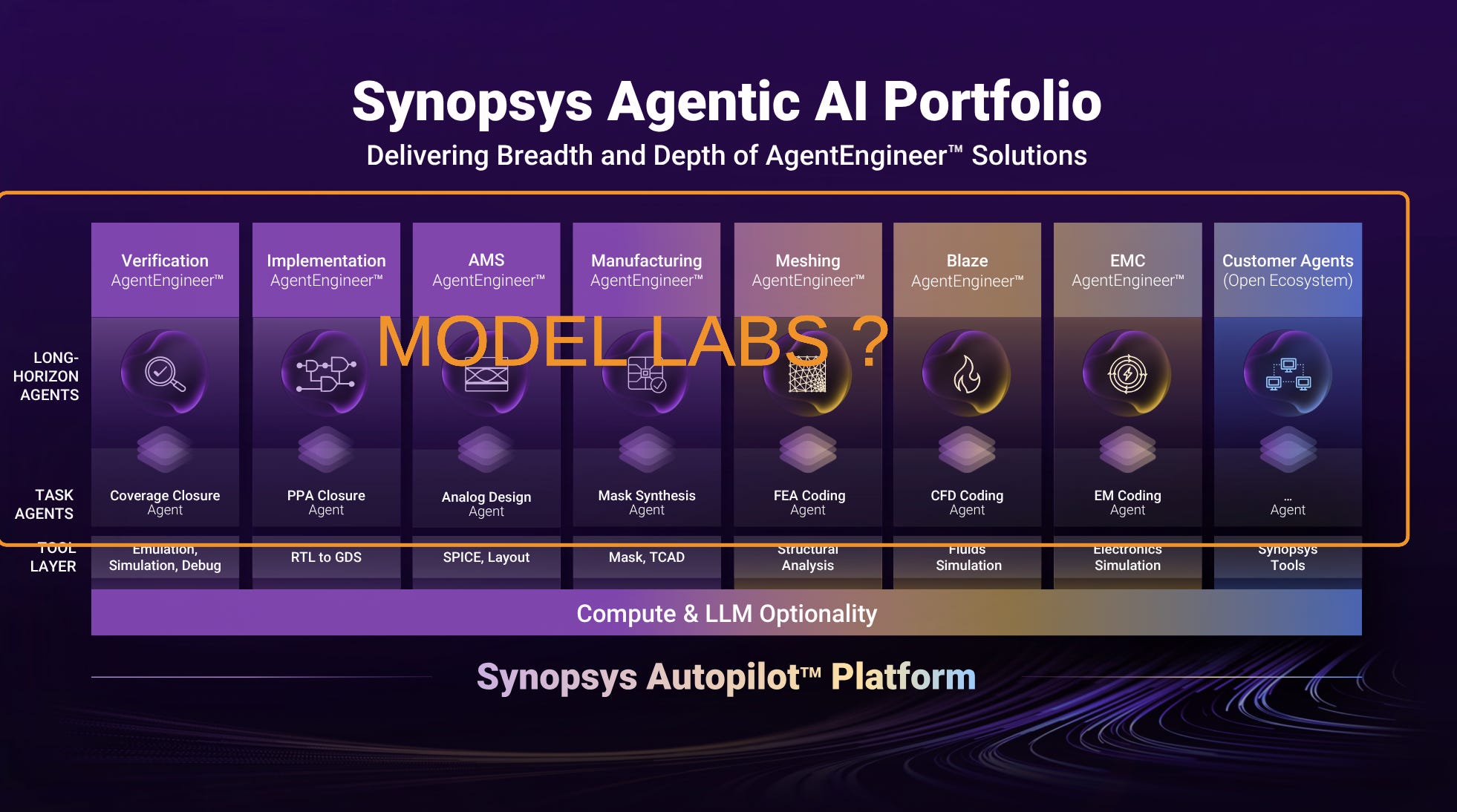
The bear case is model labs will own the agent layers circled above, and EDA vendors are limited to the tool layer.
Synopsys acknowledged these agent layers are something customers are exploring owning themselves, but suggested seen three different paths forward with customers so far:
1) Use Synopsys agentic layers
2) Roll your own
3) Use a frontier lab offering
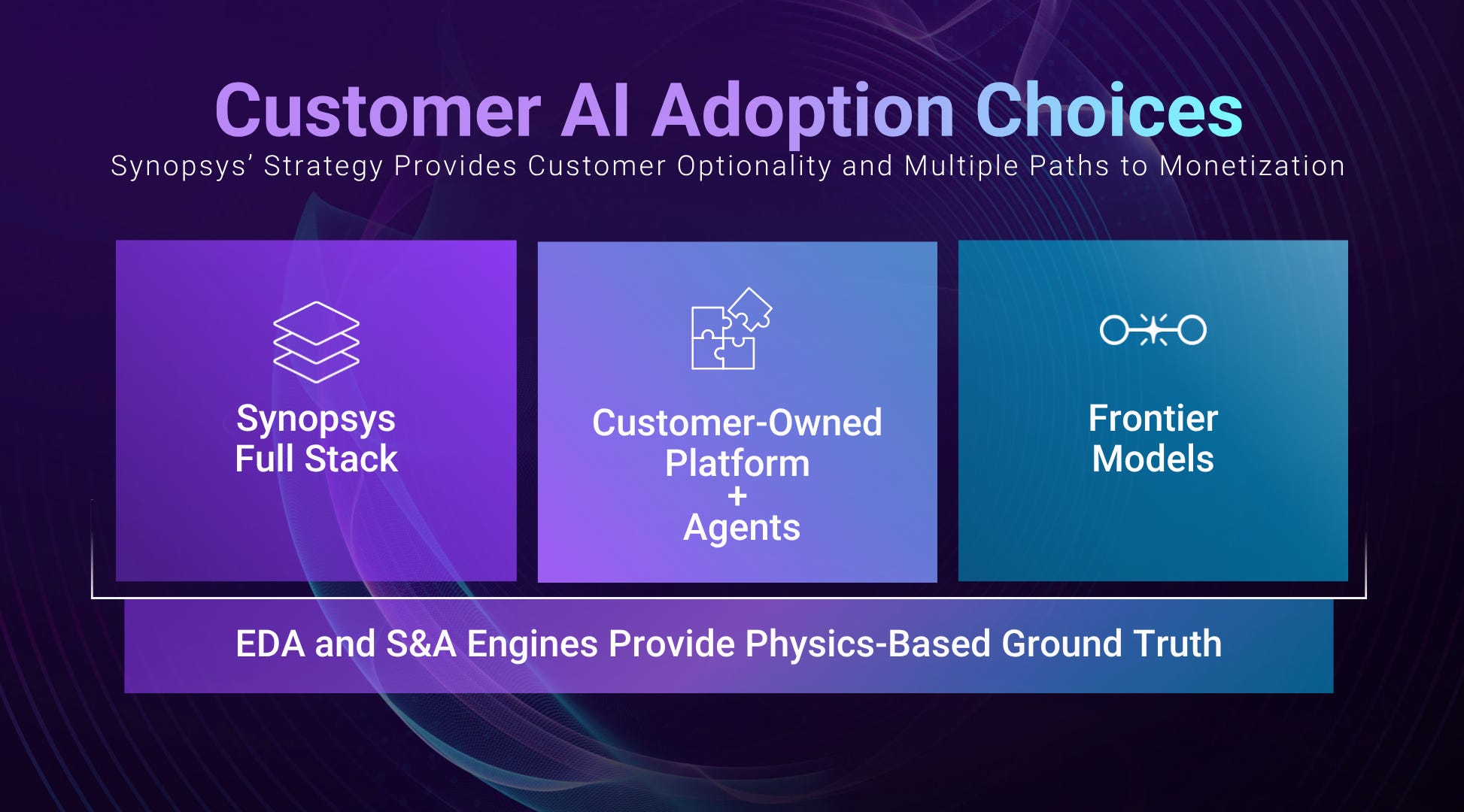
Digging into each:
1) Synopsys full stack
The customer takes everything from Synopsys. The value prop of this turnkey offering is speed-to-market for the customer, and trust that Synopsys is the domain expert here and can unlock token efficiency that others can’t:
“We have access to the guts of the tool. We have deep API that they’re not available in lane two or three.” — Sassine Ghazi
Obviously, this provides the most revenue opportunities for Synopsys:
2) Roll your own (customer-owned platform + agents)
Synopys said most early adopters are exploring this lane today; their agents still use Synopsys tool licenses, but they want to own the agentic layer.
“I have my own special sauce. I want to build my own agent... I do not want to reinvent a debug agent.” —Sassine Ghazi, describing lane-two customers
I’m not surprised most customers would land here, as customers retain optionality (can explore using different models, innovate or optimize the harness, etc), and can limit dependence on Synopsys (and reduce spend with Synopsys). Granted, you’re paying your own engineer salaries for development and maintenance instead. No free lunch.
OK, so now the surprising announcement, which I was there for :)
Paid subscribers get my thoughts on
GPT-Synopsys
Labs owning the agentic layer. Bear case? Or not?
Outcome-based pricing
Can AI replace the tool layer?
Retraining
Open-source EDA
AI simulation shortcuts
OpenAI’s commitment
Is EDA dead?
Let’s get into it.